Guide
Last updated:
February 17, 2026
10
min read

Effective business communication is the heartbeat of a successful company. In a world of hybrid offices and global workforces, how we share information determines whether a business thrives or stalls. This guide equips you with the strategies, tools, and digital solutions needed to master communication at every level of your organisation.
What is business communication?
Business communication is the process of sharing information between people within and outside an organisation. It covers everything from internal strategic alignment to external brand messaging.
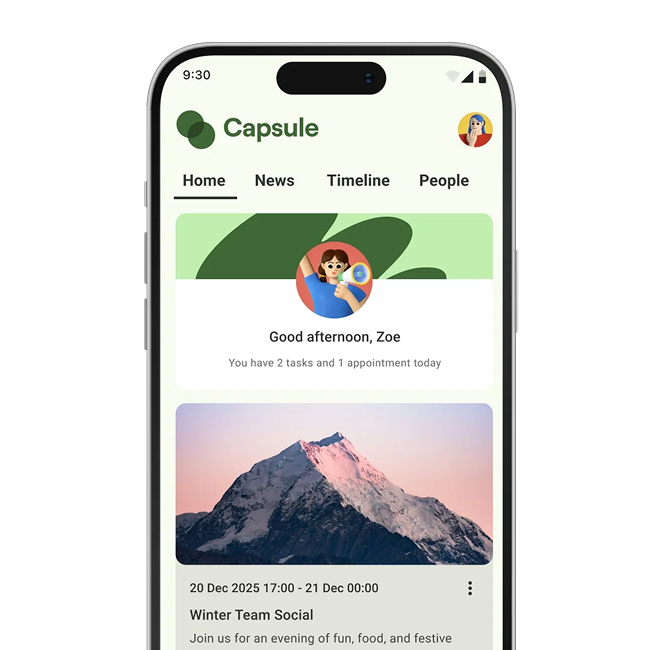
To communicate successfully, an organisation needs adaptable and accessible tools. Today, this often centres on a "digital workplace"—a centralised ecosystem where employees can access the people and information they need to succeed, often via an employee communication app.
The 5 pillars of workplace connectivity
True business communication isn't just about sending an email; it’s about how employees interact with the business as a whole:
- Alignment: Ensuring staff believe in the company’s objectives and leadership.
- Information flow: Eliminating the "search for info" that wastes up to 75% of an employee's time.
- Job satisfaction: Providing tools and recognition that make employees feel inspired.
- Social interaction: Building emotional bridges between departments to prevent "silos".
- Accessibility: Ensuring frontline and deskless workers have the same voice as head office.
The 4 main types of business communication
Most workplace information exchange falls into one of these four categories:
Type Direction Examples Internal - upward Employee to senior management Feedback forms, surveys, and pulse checks. Internal - downward Leader to employee Policy updates, company news, and CEO briefings. Internal - lateral Peer to peer Departmental collaboration and instant messaging. External Business to stakeholder PR, sales calls, vendor management, and marketing.
The power of mobile: Connecting the deskless workforce
A major challenge in modern business communication is reaching the "deskless" or frontline worker. These employees—often in retail, construction, or healthcare—lack a company email or a desk.
Employee communication apps bridge this gap by:
- Removing barriers: Allowing access to company info without a corporate email address.
- Real-time alerts: Using push notifications for urgent updates (e.g. menu changes, safety alerts, or schedule shifts).
- Mobile training: Moving policy documents and onboarding into a mobile-friendly video format.
Why is effective communication so important to business?
In the post-pandemic era, "disconnected teams" are a primary cause of high turnover. When frontline staff feel like they are missing out on company culture, they begin to feel undervalued.
Key statistics:
- 29% of projects fail due to poor communication.
- 74% of employees feel they are missing out on company news.
- 60% of workers face a "crisis" every month caused by communication breakdowns.
- Profitability increases by 21% when employees are actively engaged.
13 tips to boost business connectivity
If your organisation is facing communication challenges, use these proven tactics to "connect the disconnected":
- Communicate core company values: Make your mission visible on your intranet homepage so every decision is aligned with company goals.
- Celebrate and recognise employees: 80% of employees are more motivated when achievements are recognised publicly via social timelines or work anniversaries.
- Provide opportunities for feedback: Use pulse surveys, online forms, and quick polls to give every employee a voice.
- Make company resources easily accessible: Ensure version-controlled policies and documents are in one searchable hub for both desk-based and remote staff.
- Secure mobile capability: Use an employee engagement app to allow dispersed frontline colleagues to access information on the go.
- Drive collaboration: Optimise team collaboration by providing tools that work across different locations and shift patterns.
- Create a sense of community: Set up digital community hubs where likeminded colleagues can interact and build a culture of belonging.
- Market to each other: Feature articles and videos highlighting events in different departments to break down silos.
- Encourage a social intranet: Give everyone a voice through blogs, commenting, and instant messaging to replicate "water cooler" chat virtually.
- Create a personalised experience: Use smart delivery to show employees only the news relevant to their specific role, location, or interests.
- Modernise with tech: Replace cluttered email chains with instant messaging and intuitive mobile interfaces.
- Share news instantly: Use push notifications for urgent updates (e.g. safety alerts) to ensure information reaches the right people immediately.
- Consistent content creation: Use multimedia—video, imagery, and polls—to keep engagement high and information digestible.
What are the benefits of effective business communication?
1. Improved employee performance
Research shows that 92% of businesses think a more engaged employee performs better. Effective skills can make employees feel empowered and more connected with their company and will also help improve the performance of the workforce.
2. More productivity
Consistent business communication will give employees a wider understanding of everyone’s roles, company processes and document access. Streamlined and standardised operations will help employees utilise their time more efficiently.
3. Accountability
Effective communication in the workplace will ensure that staff know their roles, what is expected of them and their peers. This will lead not only employees holding themselves accountable for their own work but also each other.
4. Company culture
47% of jobseekers say culture is their main motivation so it is vital in employee attraction, retention and overall performance of the workforce. Good communication is the driving force behind a healthy company culture and the staple of a good team spirit.
5. Builds employee trust
By implementing a culture of two-way communication, an organisation can help cultivate trust, but also with their manager and peers. In turn, employees who have trust will have more confidence in doing their own job.
Here's some examples:
We have found some live case examples of how a pro-active and considered approach to communication skills within the workplace has improved operational ways of working for businesses, including customer service.
1. Make information easy to access
Make sure that information and relevant documents are centralised and easily accessible. This can be facilitated by a company knowledge base or centralised document management system. This is in order to ensure staff have everything they need to do their job. It will also make knowledge sharing throughout the business far easier.
Example:
Leading healthcare provider Sevita recognised the importance of centralising information and enhancing accessibility for their employees. To achieve this, they implemented a company-wide central hub for employees.
It offers role-specific news updates, a regularly updated company directory, version-controlled policies and other important documents, a comprehensive onboarding experience and an interactive ‘I have a question’ page. This gives employees one location to ask HR or IT a question, should they not be able to find the answer in resources on Sevita Source. Recognising their diverse workforce, our benefits page was expanded to show benefits to non-benefits eligible employees, such as employee discounts and recognition tools. Furthermore, people are now only receiving information that is relevant to them, increasing impact and cutting through the noise.
Recommended reading 📖: Sevita's employee engagement transformation with Oak Engage
2. Recognise achievements
80% of employees have more motivation in their work when their achievements are recognised. This can be something as small as sending a message or putting out a social media post saying ‘thank you’ or a ‘well done’. It will go a long way in motivating employees and getting the best out of them.
Example:
It was key for ScS to celebrate colleague achievements and milestones in order to create a closer community. They have a social timeline where everyone can interact, share and post their own content to promote two-way communication and foster an inclusive environment.
These social features have fostered a more inclusive and interactive workplace. Colleagues can now share updates, celebrate milestones and interact with each other’s posts. This feature has not only improved communication but also helped in building a more connected and engaged community within ScS. With Our ScS home, recognising and celebrating colleagues’ achievements has become more visible and widespread. The ability to acknowledge colleagues’ contributions publicly has boosted morale and encouraged a culture of appreciation and recognition.
Recommended reading 📖: ScS choose Oak Engage to transform how they connect and inform their colleagues
3. Consistent content creation
Content creation relevant to employees can be done in the form of relevant multimedia based content distributed to company social platforms. Not only will this encourage employees to create content and engage with each other through likes and comments, it also gives leaders another avenue to communicate updates in a more engaging manner than company email.
Example: Construction company Severfield has won over their colleagues by using personalised homepages. They have since been able to create templates for new department areas so that department heads can visualise how their areas will look and the different types of content that will go within it for business communication. This streamlines not only the user experience once the area is built, but the time in which it takes for the internal comms team to create the homepages for their colleagues.
Recommended reading 📖: Severfield upgrades their business communication with Oak Engage
4. Two-way feedback
Providing and receiving feedback is essential in business communication and gives insight into positives and negatives of employee experience. It can also give a voice to employees whilst informing of any changes that may need to be made. Feedback can be gathered through a simple chat, formal reviews or pulse surveys, which can provide findings to base business decisions on.
Example:
Employee surveys were a key part of ZIGUP's business communication strategy to measure their colleagues' thoughts and concerns about the merger which they could then address.
"After our merger we conducted an engagement survey, and at that time, engagement rates were in the 50% range. A lot of this stemmed from people feeling disillusioned and uninformed about the merger and the changes it brought. One of our first priorities was to establish a central source of truth. By consistently communicating about these changes, explaining the company strategy and keeping these conversations going throughout the year, we've seen engagement rates jump from around 50% to 78%. While there's still room for improvement, it's been a significant achievement."
Liza McNamara, Head of Internal Communications at ZIGUP
Recommended reading 📖: ZIGUP uses Oak Engage to reach frontline colleagues and overhaul their corporate brand
5. Modernise with technology
A modern intranet solution can dramatically improve company communications through its channels of dialogue. With enterprise social intranets, communication has upgraded using familiar social tech tools and hubs that help improve internal communication.
Example: Burger King UK launched BK Hub, which is a dynamic and mobile friendly platform. It has completed transformed how they communicate with their frontline and deskless employees and provides a range of features such as content sharing, recognition social timeline, advanced search and a document library.
Recommended reading 📖: Oak Engage transform Burger King UK's employee experience with the launch of BK Hub
How Oak Engage transforms business communication
We help the world’s most successful brands—like Burger King UK, Five Guys, and NatWest Group—bridge the gap between management and the frontline.
- Cloud-based intranet: Accessible anywhere, on any device, with no signal or location barriers.
- Employee app: A mobile-first solution for the modern, on-the-go workforce.
- Community hubs: Fosters a sense of belonging for remote and hybrid teams.
- Smart newsfeeds: Cuts through the noise with personalised, relevant content.
The future of work is connected. By leveraging a modern digital workplace, you ensure your workforce remains strong, collaborative, and productive, no matter where they are.
Ready to improve your business communication?
Book a demo and let us show you how to connect your disconnected teams and modernise your internal strategy.