

Blog
Last updated:
August 6, 2026
20
min read
.png)
Top Simpplr alternatives: quick comparison
- Oak Engage: Best for frontline communication and mobile intranet access
- Workvivo: Best for employee engagement and workplace culture
- Staffbase: Best for multichannel internal communication
- LumApps: Best for broad enterprise employee hubs
- Unily: Best for complex global intranet deployments
- Happeo: Best for Google Workspace organisations
- Interact: Best for content governance and structured knowledge
- Firstup: Best for personalised employee communication journeys
- Haiilo: Best for internal communication and employee advocacy
Simpplr is an AI-powered intranet and employee experience platform that combines internal communication, enterprise search, workplace integrations, employee engagement and AI assistance.
It supports communication across desktop, mobile, SMS and digital screens, with dedicated functionality for both desk-based and frontline employees. Simpplr also provides targeted content, secure messaging, workplace workflows, employee recognition and access to information from connected business systems.
Organisations therefore do not usually compare Simpplr alternatives because Simpplr lacks mobile access, personalisation or frontline functionality. They compare alternatives when they want a different platform scope, implementation approach, content model or stronger focus on a particular requirement.
The leading Simpplr alternatives include Oak Engage, Workvivo, Staffbase, LumApps, Unily, Happeo, Interact, Firstup and Haiilo.
Oak Engage is particularly relevant to organisations whose central challenge is frontline communication. Its mobile-first intranet helps businesses deliver targeted updates, push notifications, digital signage, company resources and workplace information to employees who may not regularly use a desktop or have access to corporate email.
Other alternatives prioritise different requirements. Workvivo places social engagement and culture at the centre of the experience. Staffbase specialises in communication across intranet, app, email, SMS and digital signage. LumApps and Unily provide broader enterprise employee experience platforms.
How we compared the best Simpplr alternatives
We reviewed current product information, integration documentation, independent analyst recognition and the stated positioning of each provider.
The platforms were compared across:
- Frontline communication
- Mobile access
- Internal communication
- Search and information discovery
- Personalisation and targeting
- Content management and governance
- Employee engagement
- Workplace integrations
- Platform scope
- Organisational fit
Product information was reviewed in August 2026.
Where a difference reflects platform focus rather than a documented product restriction, it is presented as a key consideration rather than a factual limitation.

Simpplr: strengths, considerations and what alternatives should offer
Simpplr provides a broad AI-powered employee experience platform rather than a conventional content-only intranet.
Its platform connects communication, workplace knowledge, enterprise search, applications and employee services through one personalised experience. Simpplr also provides low-code and no-code administration, integrations with major workplace systems and AI-powered tools for answering questions and completing routine actions.
Why organisations compare Simpplr alternatives
Simpplr is a capable and wide-ranging platform. However, its breadth does not automatically make it the right option for every organisation.
The best alternative depends on the problem the organisation needs its intranet to solve.
1. They need a more frontline-focused intranet
Simpplr supports frontline employees through mobile access, targeted content, SMS, secure messaging, digital screens and connections to workplace systems. It also allows frontline employees to access schedules, pay information and task workflows through a personalised dashboard.
However, some organisations want a platform whose central proposition is frontline communication rather than a broader employee experience platform.
Their priority may be providing quick mobile access to company updates, policies, operational information and workplace resources for employees who spend little or no time at a desk.
These organisations may prefer a frontline-focused intranet such as Oak Engage, where mobile access, flexible authentication, targeted communication, push notifications and digital signage sit at the centre of the platform.
2. They want a more focused platform
Simpplr brings together intranet content, communication, enterprise search, workplace integrations, AI assistance, recognition, employee listening and workflow functionality.
That breadth may be valuable to organisations seeking one extensive employee experience platform.
Other businesses may have a more defined requirement. They may primarily need to improve frontline communication, manage company content, strengthen workplace culture or coordinate internal communication across several channels.
A more focused platform can make it easier to prioritise implementation, ownership and adoption around the capabilities employees will use most.
3. They want a different communication model
Employee communication platforms approach publishing and distribution differently.
Some platforms centre communication around a personalised intranet feed. Others place greater emphasis on employee email, SMS, digital signage, social interaction or communication journeys.
Organisations should consider:
- Which channels their employees use
- Whether employees have corporate email
- How urgent messages are delivered
- How audiences are segmented
- Whether unread messages can be retargeted
- How communication reach and understanding are measured
The platform with the largest feature list will not necessarily have the communication model best suited to the workforce.
4. They want a different content or governance structure
Platforms differ in how they organise pages, feeds, communities, knowledge, permissions and publishing ownership.
Some organisations want a highly structured enterprise content model with detailed governance. Others want communication teams and local publishers to create content without introducing extensive administration.
The right alternative should reflect how content is produced, reviewed, approved and maintained across the organisation.
5. They need a platform aligned with their technology environment
Simpplr integrates with Microsoft 365 and SharePoint, Google Drive, Workday, ServiceNow, Salesforce, Oracle, SAP and other workplace systems.
Some organisations may still prefer a platform centred more specifically on their existing environment.
For example:
- Happeo is closely aligned with Google Workspace
- Powell Intranet is an option for organisations building directly on SharePoint
- Oak Engage integrates with Microsoft 365 while remaining an independent frontline intranet
- Firstup places employee data and behavioural targeting at the centre of communication
- Staffbase prioritises communication across a wide range of channels
Best Simpplr alternatives and competitors

1. Oak Engage: best for frontline communication
Oak Engage is a frontline-focused Simpplr alternative designed to help organisations reach employees who do not spend their working day behind a desk.
Its mobile-first intranet gives frontline employees access to targeted communication, company resources, workplace tools and essential information while keeping them connected with desk-based teams through one platform.
Oak brings together targeted internal communication, personalised feeds, mobile access, push notifications, digital signage, employee communities, AI-powered search, analytics and workplace integrations.
Smart Delivery enables communication teams to target content according to factors such as role, department, team, location and priority.
Aria provides AI-powered search across intranet content, policies, documents, workplace tools and connected information. The Oak mobile app supports QR codes, SMS and single sign-on. This helps
organisations provide secure intranet access to employees who may not have corporate email accounts. Oak also supports bring-your-own-device environments and integrates with Microsoft 365, SharePoint,
Teams and other workplace systems.
Oak Engage was recognised as a leading product in the ClearBox 2026 report. Oak received a top-five overall score among 37 providers, alongside recognition for community building, value and AI innovation.
Key Oak Engage features
- Frontline employee mobile app
- Access without corporate email
- Flexible QR code, SMS and SSO authentication
- Targeted internal communication
- Personalised employee feeds
- Push notifications
- Digital signage
- Mandatory reads
- AI-powered search through Aria
- Smart Delivery targeting
- Employee communities
- Employee recognition
- Surveys and feedback
- Forms and mobile workflows
- Analytics and reporting
- Microsoft 365 and SharePoint integrations
Oak Engage compared with Simpplr
Oak Engage and Simpplr both provide intranet content, mobile access, personalised communication, AI-powered search and employee engagement functionality.
Simpplr offers a broader AI-powered employee experience platform spanning enterprise search, communication, employee listening, recognition, AI assistance and connected workplace actions.
Oak Engage offers a more focused frontline intranet centred on mobile access, targeted communication and making essential information available to employees away from a desk.
Oak may be the better fit when frontline communication is the central requirement and the organisation wants one intranet connecting operational employees with the wider business.
Simpplr may be better suited to organisations seeking a broader employee experience platform that combines intranet functionality with AI assistance, employee services and workplace actions.
Choose Oak Engage if:
- A significant proportion of your workforce is frontline or operational
- Employees do not regularly work from a desktop
- Some employees do not have corporate email accounts
- You need flexible mobile authentication
- Targeted communication and push notifications are essential
- Digital signage forms part of your communication strategy
- You want frontline and desk-based teams connected through one intranet
- You want a focused frontline intranet rather than a broader employee experience suite
Key consideration
Oak has a more focused intranet and communication proposition than Simpplr. Organisations seeking extensive employee service orchestration or a broader AI workplace layer should compare the full scope of both platforms.
2. Workvivo: best for employee engagement and workplace culture
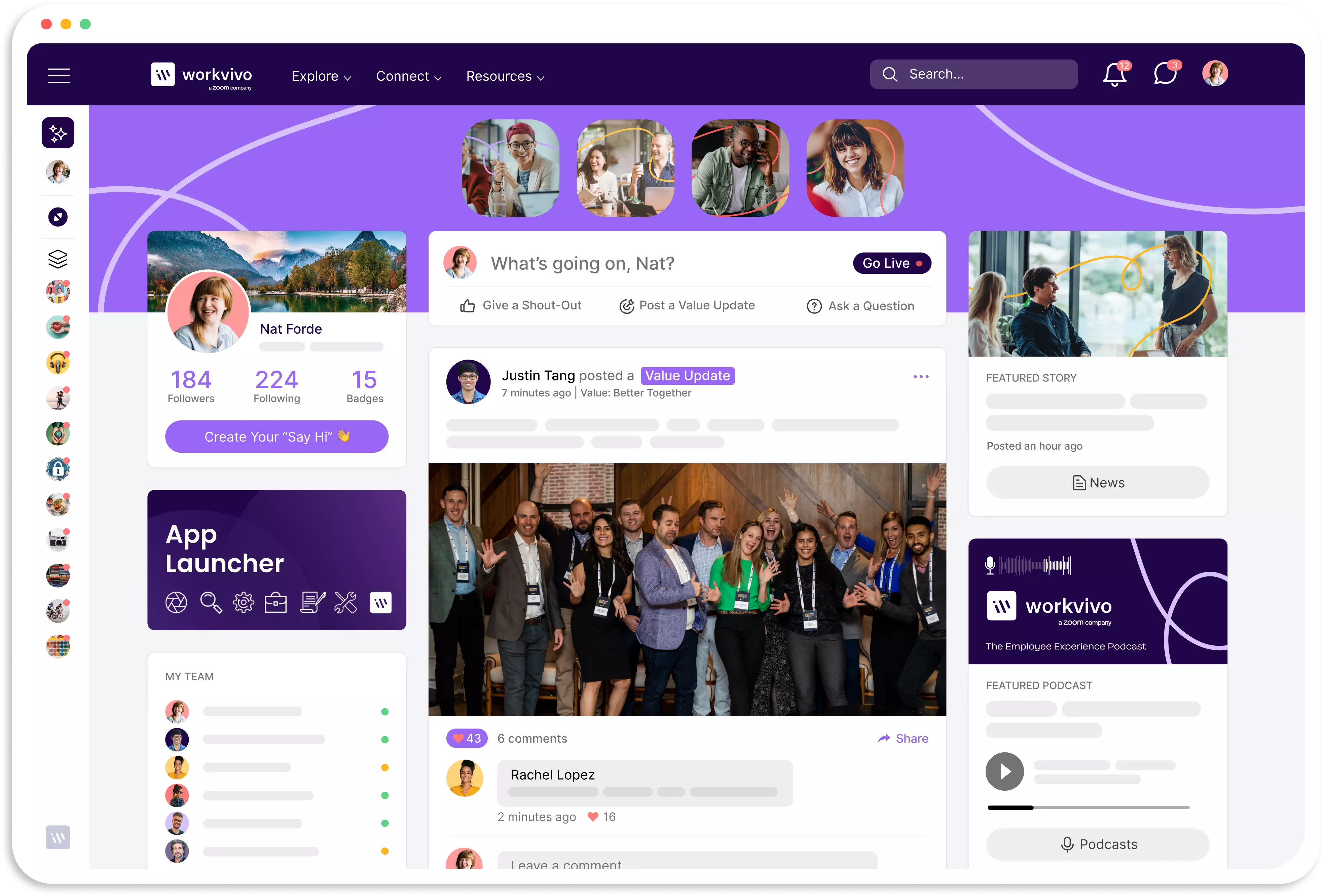
Workvivo is an employee experience platform that combines internal communication, employee engagement, social interaction, recognition and workplace knowledge.
Its social-style feed allows employees to post updates, comment, react, recognise colleagues and participate in communities. This makes company communication feel more participative than a conventional intranet built primarily around pages and document libraries.
Workvivo also provides mobile applications, company news, targeted communication, livestreaming, podcasts, employee feedback and analytics. Its mobile experience supports office-based, remote and frontline employees.
Key Workvivo features
- Social employee feed
- Company news
- Employee recognition
- Communities and spaces
- Comments and reactions
- Livestreaming and podcasts
- Employee feedback
- Mobile app
- Workplace knowledge
- Communication analytics
- Workplace integrations
Workvivo compared with Simpplr
Workvivo and Simpplr both combine communication, mobile access, engagement and workplace information.
Workvivo places greater emphasis on visible social interaction, recognition and cultural participation. Its experience encourages employees to contribute and respond rather than only consuming centrally published content.
Simpplr provides a broader AI-powered platform with more emphasis on enterprise search, employee services, workplace actions and automated governance.
Choose Workvivo if:
- Employee engagement and culture are central priorities
- You want employees to comment, react and contribute visibly
- Recognition should be part of everyday communication
- You want an intranet experience that feels familiar and social
- Communities and employee-generated content are important
Key consideration
Organisations with extensive knowledge governance, structured documentation or complex employee service requirements should compare those capabilities carefully with Simpplr.
3. Staffbase: best for multichannel internal communication
Staffbase is an AI-native employee experience and internal communication platform.
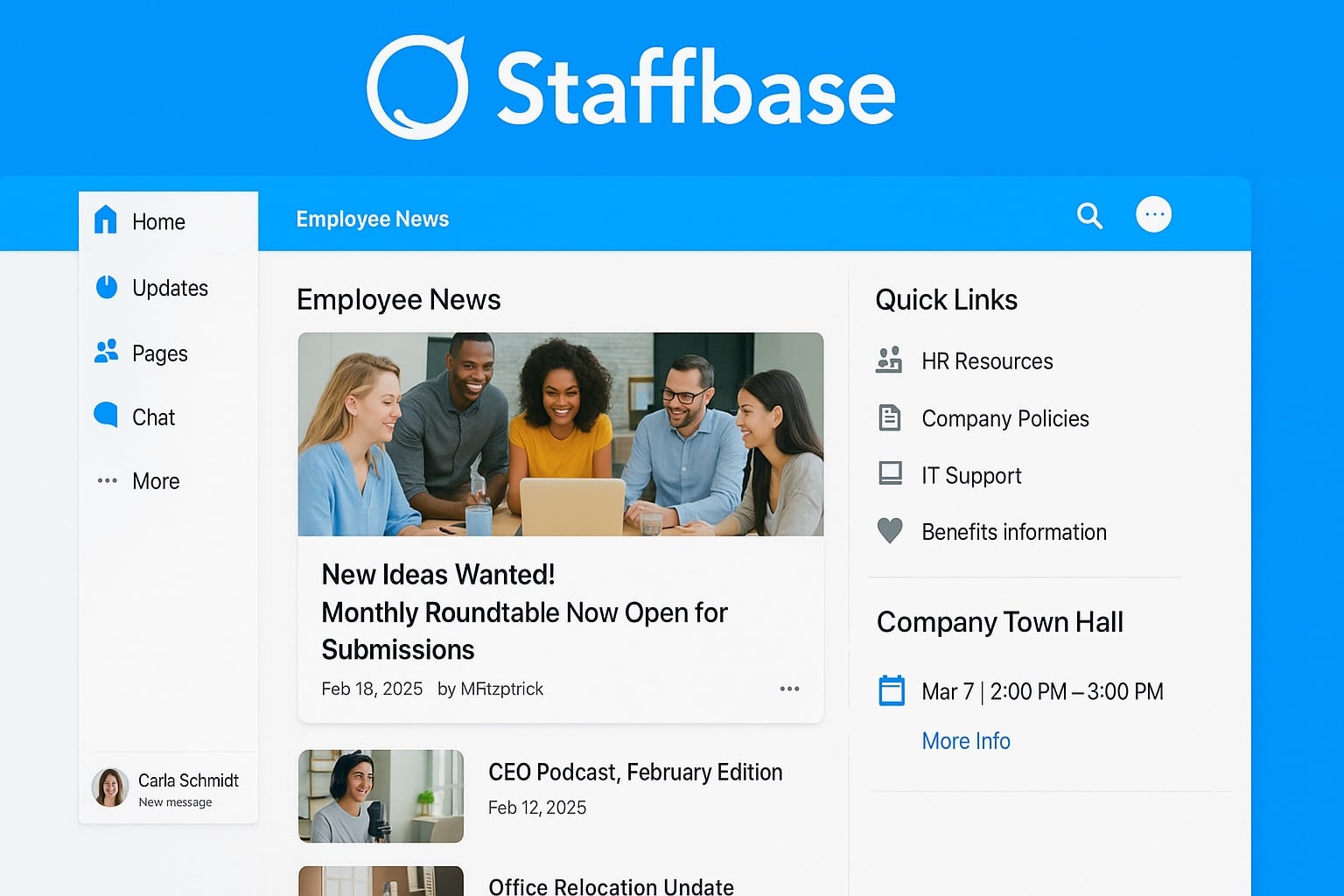
It brings together an employee intranet, branded employee app, email, SMS, digital signage and Microsoft 365 communication. Internal communication teams can coordinate content across these channels through shared planning, publishing, governance and analytics.
Staffbase can support both desk-based and frontline employees, including workers who access communication through mobile apps, SMS or physical workplace screens rather than a desktop intranet.
Key Staffbase features
- Employee intranet
- Branded employee app
- Employee email
- SMS
- Digital signage
- Microsoft 365 communication
- Central publishing
- Editorial planning
- Audience targeting
- Campaign analytics
- AI assistance
- Acknowledgement tracking
Staffbase compared with Simpplr
Staffbase places communication orchestration across multiple channels at the centre of its proposition.
Simpplr combines employee communication with a broader AI-powered intranet, enterprise search, employee listening, recognition and workplace actions.
Staffbase may be better suited to organisations whose internal communication teams need to coordinate campaigns across intranet, mobile, email, SMS and digital signage.
Choose Staffbase if:
- You manage communication across several channels
- Employee email remains strategically important
- You need SMS and digital signage
- Campaign planning and editorial coordination are priorities
- You operate across many sites, regions or workforce groups
- You need shared communication analytics and governance
Key consideration
Staffbase has expanded into a full intranet and employee experience platform, so it should not be described as merely an employee app or campaign tool. The comparison should focus on communication model and platform fit.
4. LumApps: best for broad enterprise employee hubs
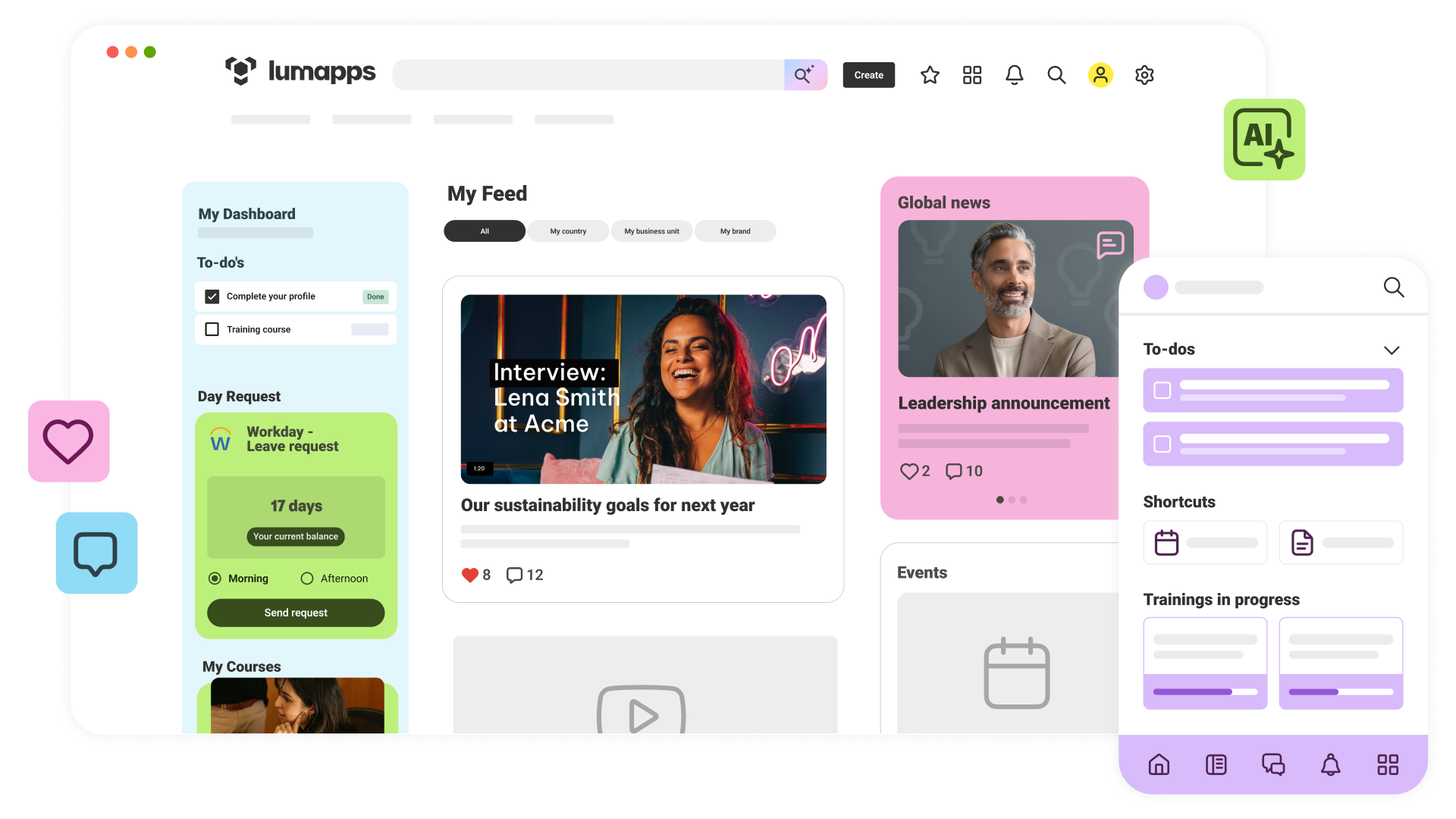
LumApps is an AI employee hub that combines internal communication, workplace knowledge, collaboration, employee services, business applications and frontline operations.
It supports Microsoft 365 and Google Workspace and can connect information and actions from systems such as SharePoint, Workday and ServiceNow. LumApps also provides communication across web, mobile, chat and digital signage.
Key LumApps features
- Enterprise intranet
- AI-powered knowledge discovery
- Internal communication
- Employee mobile app
- Digital signage
- Employee chat
- Workplace workflows
- Employee services
- Microsoft 365 integration
- Google Workspace integration
- HR and IT system connections
- Frontline operational tools
LumApps compared with Simpplr
LumApps and Simpplr are broad employee experience platforms that connect intranet content, communication, knowledge, AI and workplace systems.
LumApps presents the platform as an AI employee hub spanning communication, services, applications and frontline operations.
Simpplr positions itself as an AI-powered intranet and employee experience platform centred on communication, enterprise search, engagement and workplace actions.
The decision may depend on implementation requirements, integrations, administration and the organisation’s wider digital workplace strategy rather than one individual feature.
Choose LumApps if:
- You need a broad employee hub
- Both Microsoft 365 and Google Workspace support are important
- You want to combine corporate and frontline experiences
- Workplace services and operational tools are central requirements
- You need connections across a complex enterprise technology environment
Key consideration
LumApps has a broad enterprise scope. Organisations with a more focused intranet or communication requirement should assess whether they need the full platform.

5. Unily: best for complex global intranet deployments
Unily is an AI-native employee experience platform designed for large and complex enterprises.
The platform combines an enterprise intranet, employee app, targeted communication, social collaboration, enterprise search, content governance and workplace integrations.
Unily supports organisations ranging from approximately 1,000 to more than 100,000 employees and is designed for complex structures spanning regions, brands, departments and workforce types.
Its current AI capabilities include Unily Glass, which helps employees search and complete actions across connected systems, and Indi, which helps administrators create governed employee experiences.
Key Unily features
- Enterprise intranet
- Employee mobile app
- Targeted communication
- AI-powered enterprise search
- Enterprise information architecture
- Content governance
- Social communities
- Personalisation
- Global and multilingual support
- Workplace integrations
- Permissions and access management
- Employee workflows
Unily compared with Simpplr
Unily and Simpplr are both broad AI-powered employee experience platforms.
Unily places significant emphasis on enterprise scale, information architecture, governance and configurable employee experiences.
Simpplr emphasises ease of use, AI-powered intranet functionality, enterprise search and a unified employee experience across content, systems and tasks.
Choose Unily if:
- You are a large global enterprise
- Your intranet requires complex governance
- You operate across multiple brands, regions or business units
- Detailed permissions and information architecture are essential
- You need an extensively configurable employee experience
- You have internal resources for enterprise platform ownership
Key consideration
Unily is designed for substantial enterprise requirements. Smaller organisations or teams seeking a narrowly focused intranet may not require its full scope.
6. Happeo: best for Google Workspace organisations
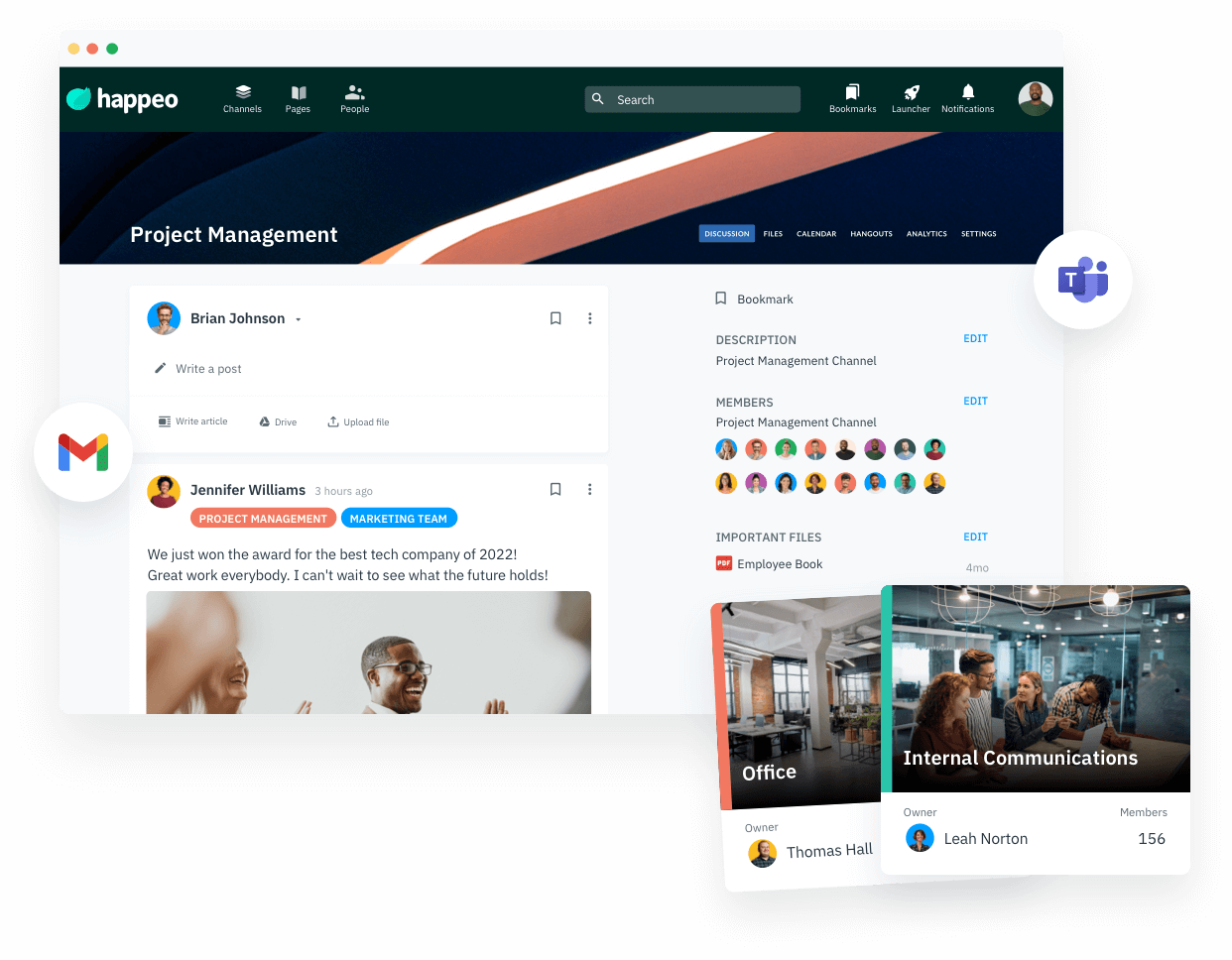
Happeo is an intranet and knowledge platform designed to bring company information, communication and collaboration into one digital home.
It combines structured intranet pages, knowledge spaces, employee channels, personalised feeds, people information and AI-powered search.
Happeo is particularly closely aligned with Google Workspace and is positioned as an AI-powered intranet for organisations using Google applications.
Key Happeo features
- Intranet pages
- Knowledge spaces
- Employee channels
- Company news
- Personalised feeds
- AI-powered knowledge discovery
- People directory
- Google Drive integration
- Gmail and Google Calendar integration
- Collaboration tools
- Mobile access
Happeo compared with Simpplr
Happeo and Simpplr both provide communication, workplace knowledge, search and integrations.
Happeo offers a more focused intranet and knowledge environment, with particular strength for organisations built around Google Workspace.
Simpplr provides a broader employee experience platform spanning employee communication, enterprise search, recognition, listening and workplace actions.
Choose Happeo if:
- Your organisation operates primarily in Google Workspace
- Knowledge sharing is a central requirement
- Google content should be surfaced naturally in the intranet
- You want structured pages and collaborative employee channels
- You prefer a focused intranet and knowledge platform
Key consideration
Organisations with extensive employee service, communication orchestration or frontline operational requirements should compare the wider scope available from Simpplr and other enterprise platforms.
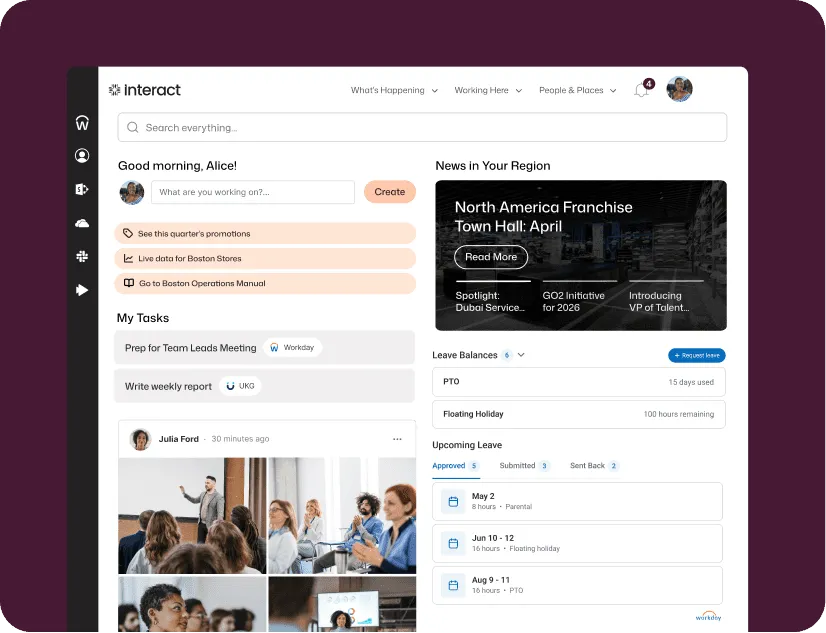
7. Interact: best for content governance and structured knowledge
Interact is an AI-native employee experience and intranet platform that brings together communication, knowledge, employee engagement and workplace tools.
Its content-management and governance capabilities include role-based permissions, publishing workflows, automated content reviews, alerts for outdated information and tools for controlling access across complex organisations.
Interact also offers a mobile-first frontline app, digital signage, secure chat, employee recognition, surveys and AI-powered search across intranet documents and connected workplace systems.
Key Interact features
- Employee intranet
- Internal communication
- Content management
- Automated governance
- AI-powered search
- Role-based personalisation
- Mobile frontline app
- Digital signage
- Secure employee chat
- Employee recognition
- Surveys and feedback
- Forms and workflows
- Analytics
- Workplace integrations
Interact compared with Simpplr
Interact and Simpplr are both broad employee experience platforms with AI, communication, search, engagement and frontline functionality.
Interact places particular emphasis on content governance, publishing controls and maintaining accurate, trusted workplace knowledge.
Simpplr provides a unified AI-powered employee experience with extensive enterprise search, communication and connected workplace actions.
Choose Interact if:
- Content governance is a major requirement
- Many departments publish and maintain information
- You require permissions, review cycles and audit controls
- Trusted policies and workplace knowledge are central
- You need a platform supporting both office and frontline employees
- Forms and internal workflows are important
Key consideration
Interact now provides broad employee experience and frontline functionality. It should not be positioned solely as a traditional or governance-only intranet.

8. Firstup: best for personalised employee communication journeys
Firstup is an intelligent communication platform designed to personalise employee communication at enterprise scale.
It uses employee attributes, behaviour and preferences to target content and automate communication journeys. Organisations can deliver updates through mobile, email, intranet, digital signage and other workplace channels.
Firstup also provides a personalised employee intranet, mobile app, workplace search, community features and connections to HR and business systems.
Key Firstup features
- Intelligent audience targeting
- Personalised communication journeys
- Behaviour-based segmentation
- Employee intranet
- Employee mobile app
- Employee email
- Digital signage
- Automated retargeting
- Enterprise search
- Communication analytics
- Community and recognition features
- HR and workplace integrations
Firstup compared with Simpplr
Firstup and Simpplr both provide personalised communication, employee intranet functionality, mobile access and workplace integrations.
Firstup places greater emphasis on intelligent communication delivery, employee journey orchestration and using employee data to determine which content should be delivered through which channel.
Simpplr offers a broader AI-powered intranet and employee experience platform that combines communication with enterprise search, recognition, listening and workplace actions.
Choose Firstup if:
- Personalised communication is your primary requirement
- You want to automate sequenced employee journeys
- Behaviour-based targeting is important
- You need communication across mobile, email, intranet and signage
- You want to retarget employees who have not engaged
- Measuring communication outcomes is a central priority
Key consideration
Firstup provides intranet capabilities, but its strongest differentiation remains intelligent communication and employee journey orchestration.

9. Haiilo: best for internal communication and employee advocacy
Haiilo is an AI-powered intranet and employee communication platform combining social intranet functionality, multichannel communication, employee listening, insights and employee advocacy.
Communication teams can distribute content across the intranet, employee app, email, Microsoft Teams, Slack and digital signage. Haiilo also allows employees to share approved company content through external social channels.
Key Haiilo features
- AI-powered intranet
- Internal communication
- Social employee feed
- Mobile app
- Email and newsletters
- Microsoft Teams and Slack distribution
- Digital signage
- Audience targeting
- Employee listening
- Engagement analytics
- Employee advocacy
- Social content sharing
Haiilo compared with Simpplr
Haiilo and Simpplr both combine intranet content, communication, engagement and workplace integrations.
Haiilo places particular emphasis on social intranet experiences, multichannel communication and employee advocacy.
Simpplr offers a broader AI-powered employee experience platform with extensive enterprise search, employee services and connected workplace actions.
Choose Haiilo if:
- Internal communication is your primary requirement
- You publish through several employee channels
- Employee listening and engagement insights are important
- Social interaction should be part of the intranet
- You want employees to share approved content externally
- Internal communication and advocacy should sit together
Key consideration
Organisations that need extensive enterprise search, workplace-service automation or complex knowledge governance should compare those requirements closely with Simpplr.
How to choose the right Simpplr alternative
Define the main problem
Start by identifying what the organisation needs to improve.
The objective may be to:
- Reach frontline employees
- Improve internal communication
- Make workplace knowledge easier to find
- Strengthen employee culture
- Consolidate communication channels
- Replace a legacy intranet
- Connect workplace applications
- Improve content governance
- Reduce platform complexity
A clear primary objective makes it easier to choose an intranet platform and separate essential functionality from features that are unlikely to be used.
Understand the workforce
Consider where employees work, which devices they use and whether they have corporate email accounts.
Organisations with large frontline workforces should assess:
- Mobile usability
- Authentication options
- Push notifications
- Digital signage
- Offline or low-connectivity access
- Workplace-resource access
- Forms and operational workflows
- Support for shared devices
- Employee access without corporate email
Office-based organisations may place more emphasis on enterprise search, knowledge management, collaboration and integrations.
Decide how broad the platform should be
Simpplr, LumApps and Unily offer broad employee experience platforms.
Oak Engage provides a more focused frontline intranet. Workvivo places greater emphasis on social engagement, while Staffbase and Firstup prioritise communication orchestration.
The right scope depends on whether the organisation needs an intranet, a communication platform, an employee experience suite or a frontline operational application.
Review communication delivery
Assess how each platform creates, targets and distributes communication.
Important capabilities may include:
- Personalised feeds
- Audience targeting
- Push notifications
- Employee email
- SMS
- Digital signage
- Mandatory reads
- Automated retargeting
- Translation
- Communication analytics
The strongest option will depend on the channels employees actually use.
Compare search and knowledge
Review what the search engine can access and how answers are governed.
Questions to ask include:
- Does search cover only intranet content?
- Can it search SharePoint, Google Drive or other repositories?
- Does it provide direct answers or only links?
- Are answers supported by citations?
- How is outdated content identified?
- Can permissions be respected across connected systems?
- Can employees search using natural language?
Assess implementation and administration
Consider how much internal resource is available for:
- Implementation
- Integrations
- Content migration
- Governance
- Employee-data management
- Platform administration
- Training
- Ongoing optimisation
A broad enterprise platform may provide greater flexibility but require more strategic ownership. A focused intranet may offer a clearer route to launch.
Examine evidence of adoption
Do not rely only on headline adoption claims.
Ask vendors to show:
- Adoption among frontline employees
- Monthly active use
- Communication reach
- Mobile activation
- Search success
- Content engagement
- Mandatory-read completion
- Differences between locations and employee groups
- Customer outcomes from organisations with a workforce similar to yours
Best Simpplr alternatives by use case
- Best for frontline communication and mobile intranet access: Oak Engage
- Best for employee engagement and workplace culture: Workvivo
- Best for multichannel internal communication: Staffbase
- Best for broad enterprise employee hubs: LumApps
- Best for complex global intranet deployments: Unily
- Best for Google Workspace organisations: Happeo
- Best for content governance and structured knowledge: Interact
- Best for personalised employee communication journeys: Firstup
- Best for internal communication and employee advocacy: Haiilo
Simpplr alternatives FAQs
What are the best Simpplr alternatives?
The leading Simpplr alternatives include Oak Engage, Workvivo, Staffbase, LumApps, Unily, Happeo, Interact, Firstup and Haiilo.
Oak Engage is best suited to organisations that need a frontline-focused intranet. Workvivo prioritises employee engagement and culture, while Staffbase specialises in multichannel internal communication.
LumApps and Unily provide broad enterprise employee experience platforms. Happeo is closely aligned with Google Workspace, Interact focuses on content governance, Firstup specialises in personalised communication journeys and Haiilo combines internal communication with employee advocacy.
Is Oak Engage a Simpplr alternative?
Yes. Oak Engage is a Simpplr alternative for organisations that need a frontline-focused intranet with mobile access, targeted communication, push notifications, digital signage, AI-powered search and workplace integrations.
Oak is particularly relevant to organisations whose employees may not regularly use a desktop or have corporate email accounts.
What is the main difference between Oak Engage and Simpplr?
Oak Engage is a frontline-focused intranet built around mobile access, targeted communication and reaching employees away from a desk.
Simpplr is a broader AI-powered employee experience platform that combines intranet content, enterprise search, communication, recognition, employee listening, AI assistance and workplace actions.
Oak may suit organisations whose main priority is frontline communication. Simpplr may suit organisations seeking a wider employee experience and workplace platform.
Does Simpplr support frontline employees?
Yes. Simpplr supports frontline employees through mobile access, targeted communication, SMS, digital screens, secure messaging and connections to workplace tools.
Frontline employees can also access information such as schedules, pay information and workflows through the platform.
Organisations should compare Simpplr with alternatives based on how central frontline communication is to the platform and the specific authentication, targeting, signage and operational capabilities they require.
Which Simpplr alternative is best for employee engagement?
Workvivo is particularly relevant to organisations that want employee engagement social interaction and workplace culture to sit at the centre of the platform.
It combines a social feed, recognition, communities, reactions, livestreaming and employee-generated communication.
Haiilo is another engagement-focused option, particularly when organisations also require employee advocacy and multichannel communication.
Which Simpplr alternative is best for internal communication?
Staffbase and Firstup are strong alternatives for organisations whose main priority is internal communication.
Staffbase combines intranet, mobile app, email, SMS and digital signage through one communication platform.
Firstup focuses on intelligent targeting, behaviour-based personalisation and automated employee communication journeys.
Oak Engage is particularly relevant when the communication challenge involves reaching frontline employees.
Which Simpplr alternative is best for Microsoft 365?
Oak Engage, LumApps, Unily, Staffbase and Interact all support Microsoft 365 environments.
Oak Engage may suit organisations that want an independent frontline intranet integrated with Microsoft 365 and SharePoint.
Unily and LumApps may suit larger organisations seeking a broader employee experience platform, while Staffbase may be appropriate when communication through Microsoft 365 forms part of a wider multichannel strategy.
Which Simpplr alternative is best for Google Workspace?
Happeo is a strong Simpplr alternative for organisations operating primarily within Google Workspace.
Its intranet is closely aligned with Google applications and combines structured pages, knowledge, communication and collaborative channels.
LumApps also supports Google Workspace and may suit organisations seeking a broader enterprise employee hub.
Conclusion
Simpplr is a broad AI-powered employee experience platform with strong capabilities across intranet content, communication, enterprise search, engagement and workplace integrations.
The right alternative depends on what the organisation needs to prioritise.
- Choose Oak Engage when frontline communication, mobile intranet access and reaching employees without corporate email are central requirements.
- Choose Workvivo when social engagement, recognition and workplace culture are the main priorities.
- Choose Staffbase when internal communication must be coordinated across intranet, mobile, email, SMS and digital signage.
- Choose LumApps or Unily when the organisation needs a broad enterprise employee experience platform.
- Choose Happeo for a Google Workspace-led intranet, Interact for structured content governance, Firstup for personalised communication journeys and Haiilo for communication combined with employee advocacy.
For organisations with large frontline or distributed workforces, Oak Engage stands out as a focused Simpplr alternative. It puts mobile access, targeted communication and frontline inclusion at the centre of the intranet while keeping operational employees connected with the wider organisation.
