

Blog
Last updated:
April 15, 2026
min read

Should your HR system handle internal comms, or do you need an intranet too? It sounds like a smart way to simplify your tech stack. Leadership wants fewer tools. Vendors are expanding their features. Budgets are tighter. But this creates a false choice. HR systems and intranet platforms may overlap, but they are built to solve different problems. Treating them as interchangeable often leads to gaps that show up later. The better question is simple – what problem are we solving first, and what happens if we ignore the other? This blog looks at intranet vs HRIS, the key differences between them, where each tool adds value and how to get the best from both.
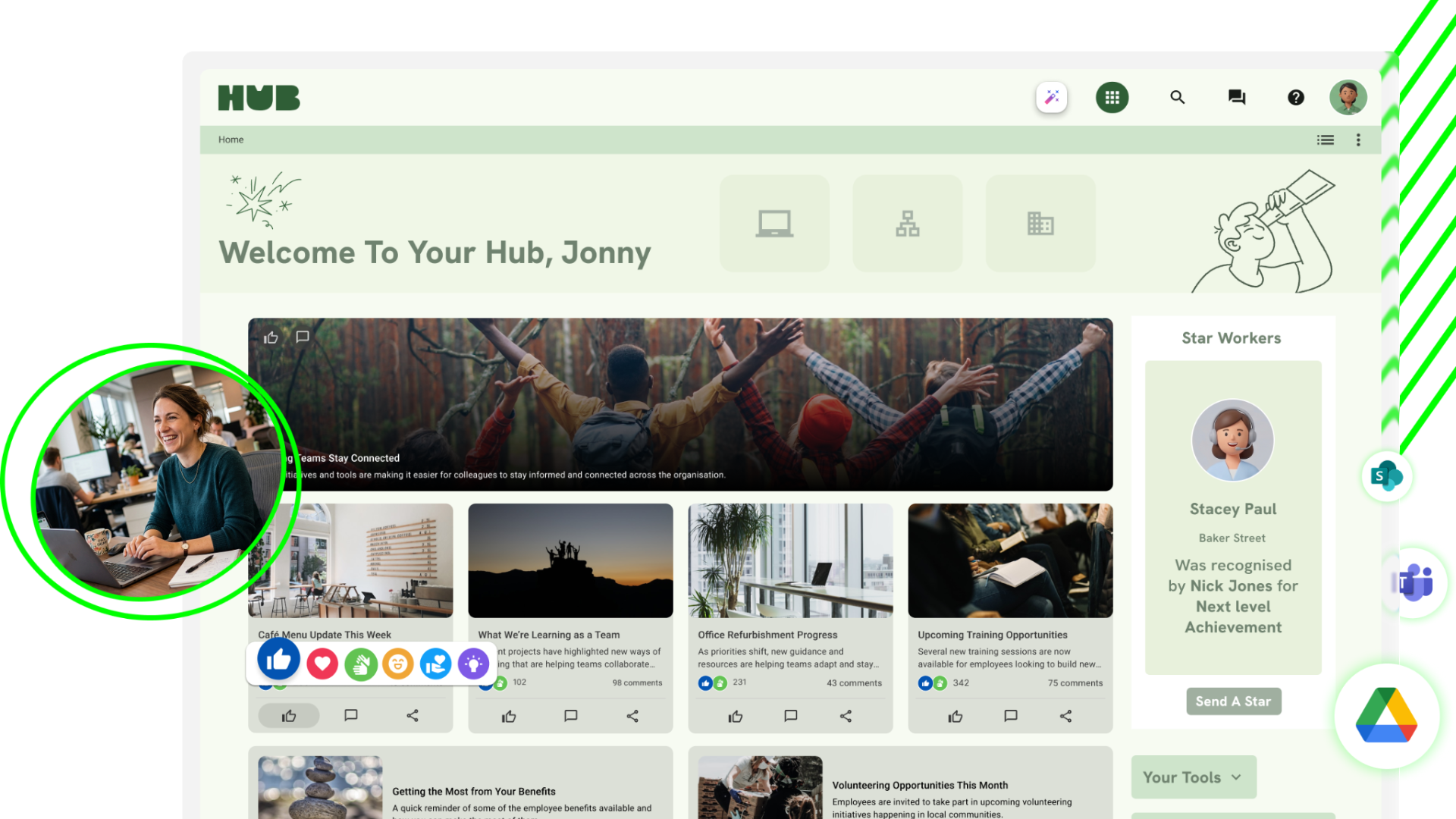
What is an intranet?
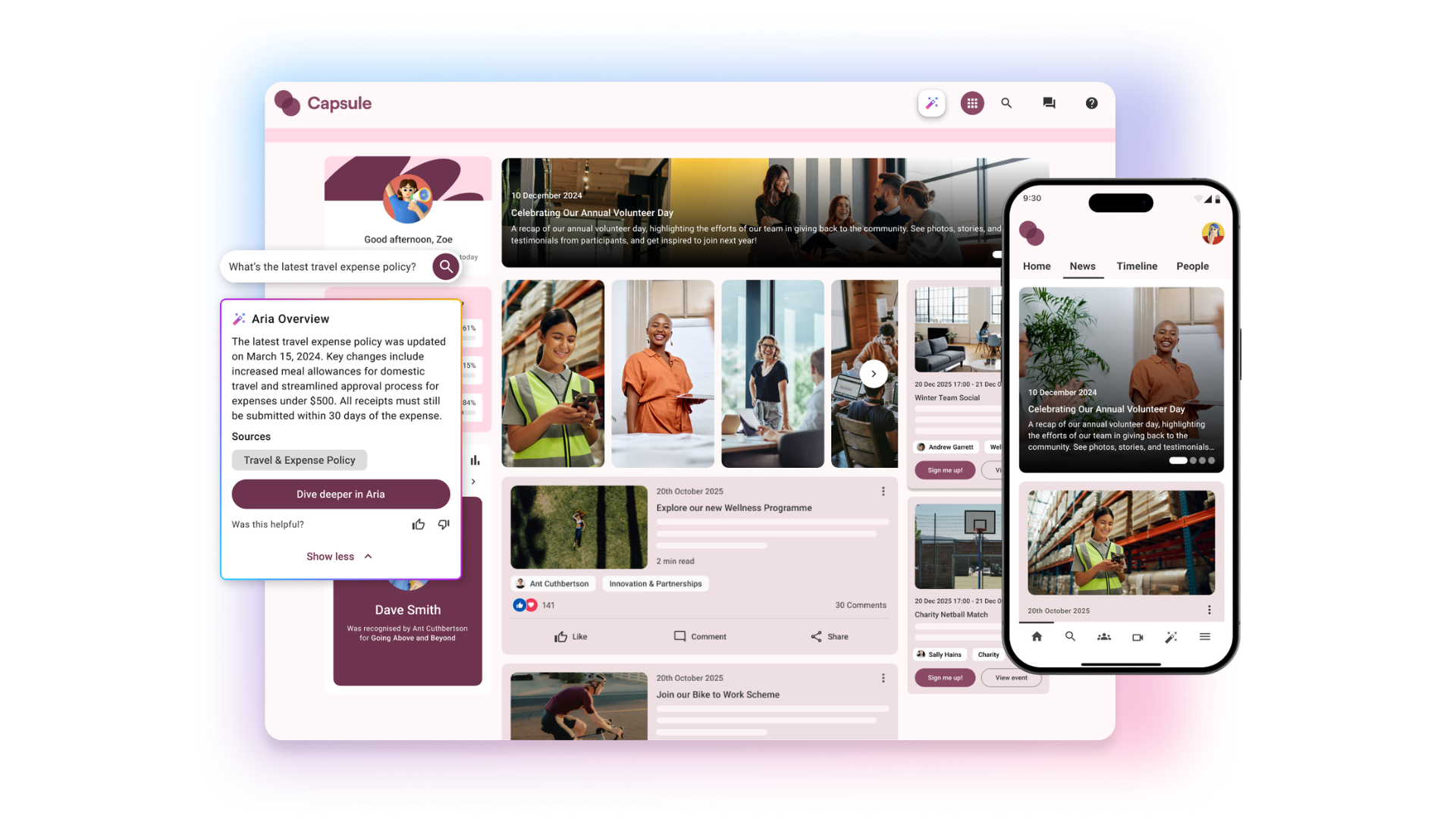
An intranet helps organisations communicate with employees, share updates and keep teams aligned. It is designed for reach, engagement and connection.
What is a HR system (HRIS)?
A HR system (HRIS) manages employee data, processes and compliance.
They may share some features, but they are built for different outcomes.
Why the intranet vs HRIS debate exists now
Software is starting to overlap
HR platforms have expanded. Many now include communication features, surveys, employee journeys, recognition and directories. At the same time, intranet and internal comms platforms have expanded too. They now include workflows, HR helpdesk, people management tools and onboarding. On paper, they can look similar. But in reality, they were designed around different priorities.
Leadership wants simplification
Leadership teams are under pressure to simplify the stack. One platform sounds easier and cheaper to manage than two and it’s a cleaner story for IT and finance. But simplifying your tech stack shouldn’t come at the cost of capability.
Overlap is mistaken for replacement
This is where decisions go wrong. The problem is not that the overlap exists – the overlap is real. Replacement is something different. Just because a feature exists inside a platform doesn’t mean the wider business need is solved.
Intranet vs HRIS: The key differences
The simplest way to understand intranet vs HRIS is to stop comparing lists of features and instead focus on the primary job each system exists to do.
What HR systems are built for
A strong HR system is primarily built to manage people data and people processes. It acts as the system of record for employee information.
It supports:
- Employee records
- Workflows and approvals
- Compliance and governance
- Onboarding and lifecycle processes
Its strengths are:
- Data accuracy
- Process consistency
- Control and audibility
What intranet/internal comms platforms are built for
A strong intranet or internal comms platform is primarily built to make workforce communication actually work. It acts as a system of reach, alignment and activation.
It supports:
- Company-wide communication
- Leadership updates and manager communication
- Frontline reach
- Change communication
- Ongoing organisational alignment
Its strengths are:
- Targeted communication
- Visibility and relevance
- Engagement and feedback
- Communication analytics
Why HR systems and intranets have different strengths
They solve different problems. One system is designed around people process and operational control. The other is designed around communication, clarity, connection and action. An organisation may need both. An organisation may also prioritise one before the other. But it should do this with a clear understanding of which problem is being prioritised and which remains unresolved. Without that clarity, teams end up comparing features instead of looking at capability gaps.
What HR needs from a HR system
HR is not just trying to communicate with employees. HR is responsible for the operational foundation of people management. This includes:
- Data accuracy
- Reliable employee records
- Process control across onboarding, offboarding and role changes
- Approvals, documentation and compliance-related workflows
It can also include performance cycles, talent processes, payroll-related coordination, absence, benefits and policy administration depending on the platform. HR often needs auditability, consistency and structured execution. These needs cannot be replaced by a platform whose main job is communication.
Why an intranet is not an HR substitute
An intranet can fully support HR. It can improve:
- The employee-facing experience of HR initiatives
- Onboarding and make employees feel more welcomed and connected
- Visibility for HR programmes and policy changes
- Engagement and can help reduce confusion
But that does not make it an HR operating backbone. If the real business problem is weak process infrastructure, fragmented employee records, or poor governance, an intranet will not solve those challenges. This blog isn’t about how an intranet replaces a HR system. It’s getting clear about what each of them can do for your organisation.
What internal comms needs from an intranet
Internal comms is not just trying to publish
Internal comms isn’t just trying to find a place where information can sit. Internal comms purpose is to make sure communication reaches the right people, is understood, feels relevant and drives action or alignment. This is a very different challenge from maintaining clean employee records or moving people through workflows. Internal comms is operating in a world of distraction, message overload, competing channels and the broken manager cascade. The real challenge is not whether a message exists. The challenge is whether it lands.
The operating needs of modern internal comms:
- Broad workforce reach
- Ability to work across desk-based and frontline employees
- Targeting by role, region, location, team, or function
- Publishing speed with appropriate governance
- Support with leadership communication
- Ability to enable managers, not just senior senders
- Ability to run campaigns, not just post updates
- Feedback loops and signals from the workforce
- Analytics that show whether communication was seen and engaged with
- Reduce noise while increasing relevance
It also needs to support change, transformation, launches, policy shifts, operational updates, culture work and day-to-day alignment. These are not secondary needs. In many organisations, these are core to execution.
Why an HR system is not automatically a comms destination
Even when an HR system includes communication features, that does not automatically make it the best environment for internal communication. Employee behaviour matters. Many employees use HR systems transactionally. They go there to complete tasks, access records, or deal with specific HR moments. This is not the same thing as treating the platform as a communication destination or daily source of company news. Communication effectiveness depends on habit, relevance, accessibility, targeting, timing and ease of engagement. If people do not naturally use the platform for those things, then having the feature is not enough. A message being posted is not the same as the workforce being informed, aligned or activated.
Where HRIS and intranet platforms overlap
HR use cases
- Employee records and profile data
- Process milestones
- Approvals and structured workflows
- Compliance and policy acknowledgement
- Lifecycle administration
- Formal HR tasks tied to employee status and administration
These are typically led by HR systems, even when communication around them may happen elsewhere.
Internal comms use cases
- Company-wide updates
- Targeted business announcements
- Change communications
- Leadership messaging
- Manager briefings
- Frontline communication
- Operational updates
- Campaigns designed to shift awareness or behaviour
- Ongoing employee connection and alignment
These are typically led by intranet/internal comms platforms, even when HR data may help segment audiences.
Shared use cases
- Onboarding
- Policy communication
- Recognition
- Surveys and feedback
- Employee journeys
- Culture reinforcement
- Directory and people information
- Events and participation
- Some elements of employee experience and engagement
These are the places where the debate often gets blurred. Both categories can play a role here but from different starting points and with different strengths.
The biggest mistake: confusing “can do” with “built for”
Many platforms can publish an announcement, send messages and host content. But that doesn’t mean they are built to do those things well at scale. A checkbox feature is not the same as real capability. That capability requires design choices, user behaviour, governance, relevance, accessibility and analytics. Without those things, the feature may exist while the problem still remains
Instead of asking what a platform can do, ask:
- Do employees actually use it for communication?
- Is it easy for comms teams to use strategically?
- Can we target the right audiences easily?
- Does it work well for frontline teams?
- Can managers use it effectively as part of the communication chain?
- Can it support repeated communication behaviour, not just occasional notices?
- Does it generate useful insight into what landed and what did not?
- Is it built to support communication as an ongoing operating capability?
These are much stronger evaluation questions than simply asking whether a feature exists.
What remains unsolved if the business chooses HR-first
In many organisations, choosing a HR system first might be the right way to go. But it helps to be honest about what that does and does not solve.
Why HR-first may still be the right choice
- If employee data is weak, processes are fragmented and HR operations are too manual, HR technology may need to come first
- If compliance and workflow consistency are the biggest risks, that may be the right priority
- If onboarding and lifecycle administration are broken at the operational level, that may justifiably outweigh communication investment in the short term
This is not a criticism of that decision. It is a reminder to make the trade-off consciously.
What communication gaps often remain
- Important updates may still be hard to reach across the workforce
- Frontline or dispersed workers may still be underserved
- Communication may still depend too heavily on line managers or local workarounds
- Audience targeting may remain limited
- Company context may still be fragmented across channels
- Leadership communication may still lack a consistent destination
- Internal comms may still lack the analytics it needs
- Change campaigns may still be difficult to orchestrate well
- Employee attention may still be scattered
So while the HR foundation may improve, communication effectiveness may remain a challenge.
The leadership implication
Choosing HR first can be a smart decision. But it does not mean internal communication has automatically been solved. The mistake is not prioritising HR. The mistake is assuming a comms-adjacent layer inside the HR system removes the need for real communication capability. Leadership should make that trade-off explicit, not accidental.
What remains unsolved if the business chooses intranet-first
The reverse is also true. If the organisation prioritises communication and alignment first, that may be entirely rational, but it still does not replace foundational HR infrastructure needs.
Why intranet-first may still be the right choice
- Some organisations are not failing mainly because of HR processes
- They are failing because communication is fragmented, managers are overloaded, frontline workers are disconnected and key initiatives are not landing
- In those situations, improving communication and alignment may be the more urgent business move
- If change fatigue is high, employee attention is scattered, and the business lacks a strong communication environment, intranet-first may be a smart priority
- Again, that can be a strategic choice
What HR infrastructure gaps can remain
- Employee records may still be messy or fragmented
- Manual workflows may continue
- Compliance administration may remain inefficient
- Lifecycle processes may remain inconsistent
- Auditability and process control may still be weak
- HR may still be spending too much energy on administrative workarounds
So while the communication environment improves, core HR process maturity may still lag behind.
The leadership implication
An intranet can amplify HR significantly. It can make HR initiatives more visible, better understood and better adopted. But it is not a substitute for a real HR operating foundation when that foundation is what the business lacks. So this is not a “replace one with the other” conversation in either direction. It is a prioritisation conversation.
Why intranet and HRIS work better together
The strongest organisations usually stop trying to force a winner-takes-all answer and instead ask how both capabilities can strengthen each other.
Onboarding
- The HR system handles records, task flow, milestones and structured process
- The intranet handles welcome, orientation, culture, context, communication and connection
- Together, they create a better new starter experience
- Without the HR system, onboarding may lack operational structure
- Without the intranet, onboarding may feel transactional, fragmented, or impersonal
- The best experience combines operational clarity with communication and belonging
Policy rollout
- The HR system may govern acknowledgement and formal process requirements
- The intranet can explain the change, target the right groups, provide context, answer common questions and reinforce awareness over time
- One handles formal compliance
- The other helps the policy actually land and make sense
Change communication
- HR data can help identify relevant audiences
- The intranet can deliver targeted updates, leadership messages, manager packs, FAQs and follow-up communication
- This is especially powerful in large, complex, frontline-heavy, or multi-location organisations
- Change does not fail only because process was unclear
- It often fails because communication was weak, inconsistent, or badly distributed
Recognition, culture and engagement
- HR may own programme logic, cadence and governance
- The intranet makes the experience visible, ongoing and participatory
- It turns recognition or culture from a process into a lived communication environment
- This is where employee experience becomes much more tangible
Frontline communication
- HR data may define who people are
- But that does not by itself reach them in a relevant or timely way
- The intranet helps translate that workforce context into actual communication and engagement
- This is particularly important where large groups of workers are mobile, deskless, dispersed, or operationally busy
Why this becomes a budget decision
If the distinction is this clear, why do organisations still end up framing this as one decision between competing categories?
The organisational dynamic
- Leadership often wants one neat investment story
- Adjacent functions get pulled into the same budget conversation
- HR is asked why it cannot cover internal communication
- Internal comms is asked why it cannot ride on top of an HR platform
- IT and finance often reinforce the pressure to simplify
- Both functions then start stretching their narrative to protect their investment case
- This is understandable, but it is not ideal
What this does to decision-making
- Requirements get blurred
- Real capability gaps get hidden
- Platforms get oversold as substitutes
- The organisation starts comparing categories before agreeing on the business problem
- Internal politics begin to shape the buying logic more than operational need
- The end result is often a weaker decision, even when the chosen platform is strong in its own category
The real issue
- This should not primarily be a turf war between HR and internal comms
- It should be a discussion about which organisational capabilities matter most right now
- Framing it as HR versus IC often makes both teams defensive
- Framing it as people process versus communication capability creates much more strategic clarity
- The healthiest organisations do not ask which function wins
- They ask which business problems they cannot afford to leave weak
Best practices for evaluating intranet vs HRIS
The most effective approach is not to pick one. It is to evaluate each platform based on the job it needs to do.
Start with the problem
Are you struggling with processes, data and workflows? Or with communication, reach and alignment? Your priority should reflect your biggest gap.
Map your workforce reality
What is the reality of your current workforce? Ask yourself the following questions which will make the need for a true internal comms platform much clearer:
- Is the workforce frontline-heavy?
- Is it multi-location?
- Is it multilingual?
- Is it dispersed or deskless?
- Is the organisation going through significant change?
- Does too much communication depend on managers?
- Does HQ struggle to reach the edge of the organisation?
Be clear on trade-offs
- If we prioritise HR first, what communication problems remain?
- If we prioritise intranet first, what HR process problems remain?
- Which stakeholders carry that cost?
- What inefficiencies or risks continue?
- Leadership does not need to buy everything at once
- But it should be honest about what is still missing
Assess integration value
- How much stronger does the employee experience become when HR data powers better communication?
- How much stronger do HR initiatives become when they land in a platform designed for reach and engagement?
- How much stronger does targeting become when systems are connected properly?
- This is often where the best long-term answer emerges.
Evaluate by outcomes, not category claims
- Avoid being distracted by broad vendor positioning
- Avoid buying based on who claims to cover the most ground
- Instead ask
- What outcomes are we actually trying to improve?
- Is the goal process integrity?
- Is the goal communication effectiveness?
- Is the goal both over time?
- That leads to a much more disciplined decision
Do’s and don’ts
Do:
- Define the primary business problem first
- Treat HRIS and intranet as complimentary
- Evaluate real usage – not just features
- Plan for integration early
- Use both to provide employees with a single source of truth
- Align HR and internal comms around shared outcomes
- Focus on the employee experience
Don’t:
- Assume overlap equals replacement
- Buy based on ‘all-in-one’ claims
- Ignore frontline communication needs
- Force one team to stretch beyond its core role
- Let budget structure dictate capability decisions
- Duplicate content
How HR and internal comms can build a joint business case
The best version of this discussion is not a fight over whose system wins. It is a shared business case built on distinct roles.
Shared business outcomes
- Better employee experience
- Better alignment
- Better change adoption
- Clearer communication
- Stronger manager enablement
- More connected frontline workforce
- Higher visibility for important initiatives
- Better participation and engagement
These outcomes matter to both HR and internal comms, even if they contribute differently.
Where Oak Engage fits
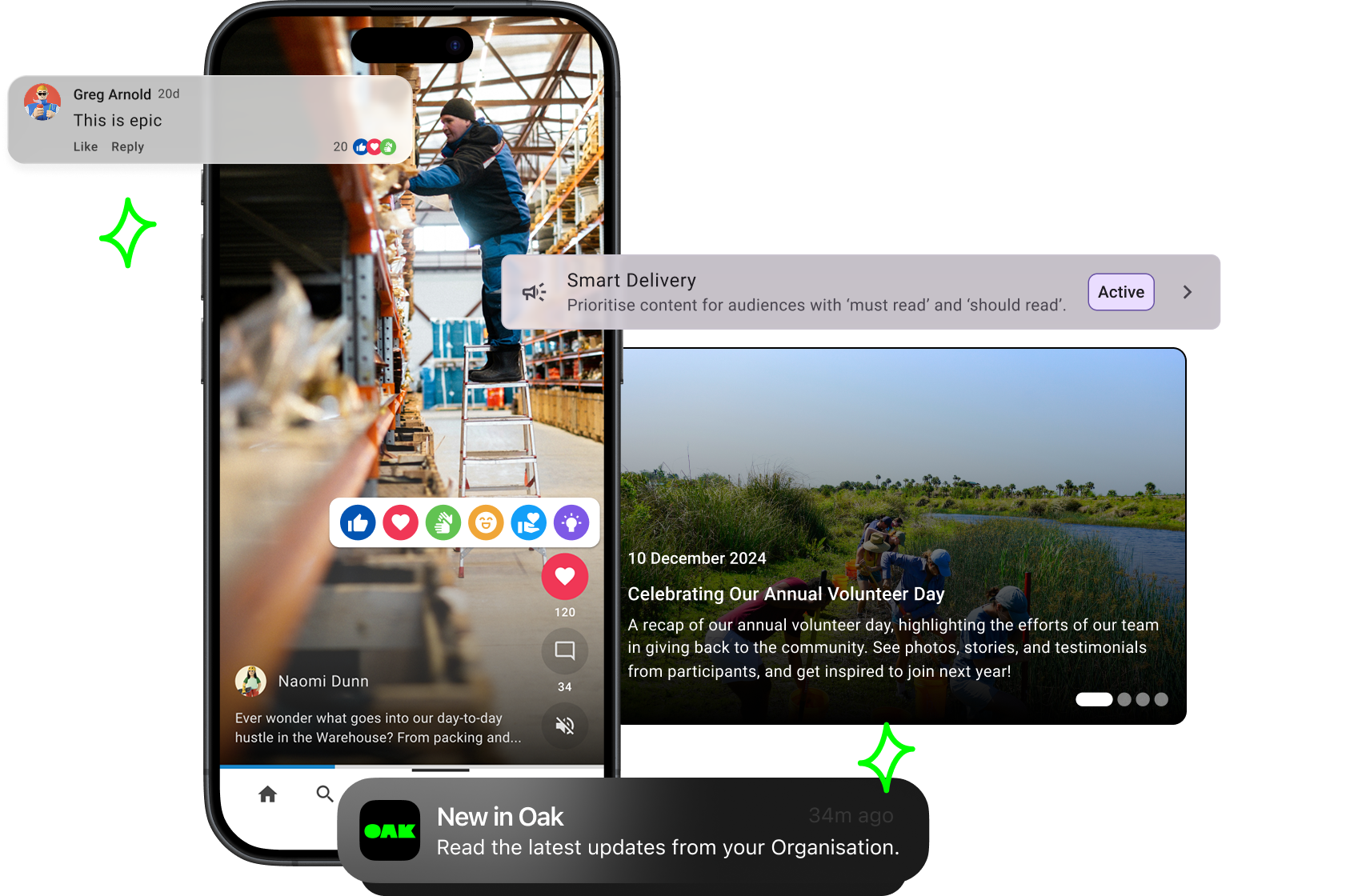
Oak Engage is not an alternative to a HR system. HR systems like Workday, HiBob and similar platforms are built for serious people operations needs. Oak is not trying to absorb that category – they’re solving a different problem.
Oak solves the communication and alignment problem properly and is built for:
- Workforce reach
- Targeted communication
- Frontline inclusion
- Manager communication and leadership visibility
- Engagement, clarity, relevance and action
It also helps organisations turn communication into an operating capability rather than a side effect of another platform. That is the gap many organisations still have even after investing in HR technology.
Get in touch with one of our friendly team today to see how we can solve your comms challenges.
