

Blog
Last updated:
March 17, 2026
8
min read
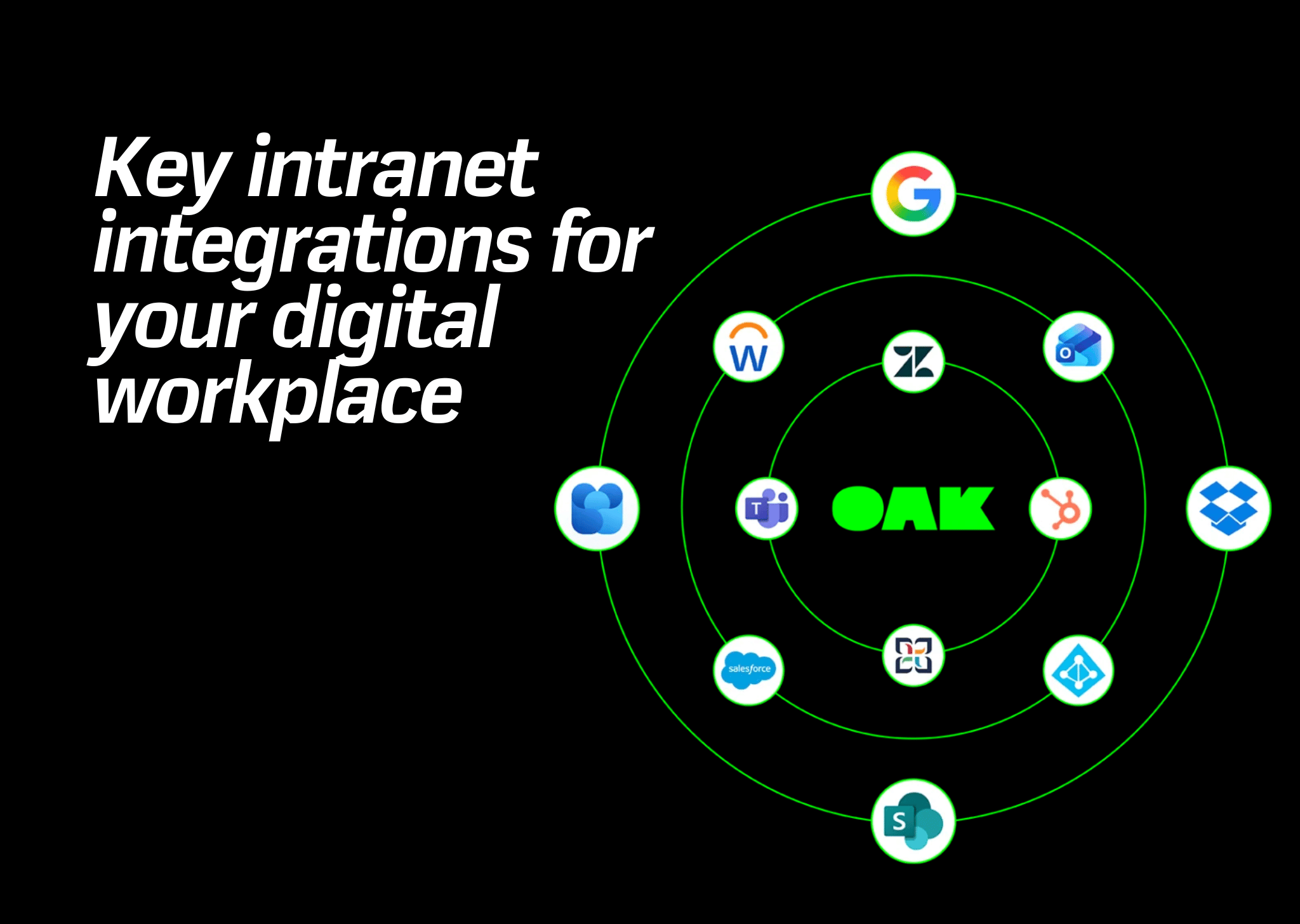
How many apps and tools do you think the average worker uses? The average desk worker uses 11 to 13 different applications to complete their daily tasks. Overall, companies with over 500 employees use 93+ systems on average.
The data tells a clear story: we are overwhelmed. 73% of business professionals report regularly using workarounds—like screenshots and manual data entry—to share data between systems that should be integrated but aren't (Okta). Furthermore, approximately 48% of enterprise apps are “shadow IT,” meaning they’re used by employees without official IT approval—an IT nightmare when enterprise security is paramount.
Businesses are looking to move toward more platform singularity. Despite this, nearly half of employees say they struggle to find the information they need, and a third miss important updates due to the multitude of apps (Gartner).
The solution? Optimising your information infrastructure. One of the best ways to do this is with a company intranet that enables you to connect all your tools from one place through integrations
What are intranet integrations?
Intranet integrations use APIs to connect your intranet with the apps and tools your employees use on a regular basis. These connections mean your employees can access information and complete actions across multiple platforms all from one tab.
This is incredibly useful when you consider that workers switch between apps, tabs, or platforms on average 33 times per day, with 17% switching more than 100 times. A study by Lokalise found that the tech, hospitality, and healthcare industries are the most affected by "tool fatigue."
8 key intranet integration categories
To build a high adoption, user friendly digital workplace, your intranet should integrate with all the key apps and tools your workforce uses. These tools and tech can be split into 8 different categories:
- Productivity and Collaboration: Centralising suites like M365 and Google Workspace.
- HR Information Systems (HRIS): Syncing people data from Workday, BambooHR, or Hibob.
- Communication and Messaging: Connecting real-time tools like Slack and Teams.
- Project and Task Management: Surfacing tasks from Jira, Asana, or Trello.
- ITSM and Knowledge Bases: Integrating support from ServiceNow or Zendesk.
- Authentication and Security (SSO): Securing access via Okta or Azure AD.
- CRM and ERP Systems: Pulling business data from Salesforce or SAP.
- Analytics and Reporting: Embedding live data from Power BI or Tableau.
The top 5 Oak Engage integrations for a unified digital workplace
Oak Engage offers a wide array of native connectors, but these five are the most critical for eliminating tool fatigue and making your intranet the "single source of truth" that brings your existing tools to you.
1. Microsoft 365 and Microsoft Teams
Most enterprises live in Microsoft 365, but information often gets trapped in silos across Outlook, Teams, and SharePoint. Oak’s deep integration ensures your intranet acts as the pulse of your Microsoft ecosystem.
- Oak for Teams: Instead of making employees leave their chat interface to read company news, bring the intranet to them. Access the full Oak experience as a dedicated app within the Teams sidebar.
- Unified search and file sync: Search for SharePoint and OneDrive files directly from Oak. You can surface documents on your intranet pages while maintaining all existing Microsoft file permissions.
- Outlook at a glance: Sync calendars and view your inbox status directly from your Oak dashboard, allowing employees to plan their day without toggling between windows.
✅ The outcome: Employees start their day in one place, reducing the mental tax of switching between communication and productivity tools, saving time and improving productivity.
“By integrating with our key systems, Oak has empowered our people with one central hub. This has also allowed us to streamline access to multiple tools so our people have everything they need in one secure place.” - Isaac Leach, Operations Manager at Pluralsight
2. Google Workspace
For organisations that run on Google, Oak acts as a powerful engagement layer that sits over your productivity suite, making "work" feel more social and connected.
- Universal search: Use Oak’s search bar to find Google Drive files alongside company news and policies. No more digging through folders to find that one specific doc.
- Live embedding: Display and collaborate on Google Sheets, Docs, and Slides directly within Oak pages. Updates made in the doc reflect instantly on the intranet.
- Frictionless SSO: With Google SSO, employees are automatically logged into Oak the moment they open their browser, removing the "forgotten password" barrier to entry.
- ✅ The outcome: Your Google Drive moves from being a "file graveyard" to a living part of your internal communications, making collaboration feel instantaneous.
3. HRIS and people data (Workday, BambooHR, Hibob)
Your HRIS holds vital data, but it is often a platform employees only visit once a month. By integrating your HR software, you transform Oak into a daily self-service portal.
- Automated user sync: Save IT and HR hours of manual work. When a new hire is added to your HRIS, their Oak profile is automatically created and populated with their role, department, and location.
- Self-service widgets: Allow employees to view PTO balances or access payslips through secure, private widgets on their personal Oak homepages.
- Automated milestones: Never miss a work anniversary or birthday. Oak can automatically trigger celebrations in the social feed based on HRIS data, building culture without manual effort.
✅ The outcome: HR teams field fewer "how much holiday do I have left?" questions, and employees feel seen and celebrated from day one.
4. Single sign-on (Okta, Azure AD, OneLogin)
Security is the foundation of the digital workplace. Oak integrates with leading identity providers to ensure that "simplicity" doesn't come at the cost of safety.
- One-click access: Using SAML 2.0 or OpenID, employees gain instant access to Oak and all its connected third-party apps through a single set of credentials.
- Instant offboarding: When an employee leaves the company, revoking their access in your centralised identity provider automatically secures their Oak account, ensuring sensitive company data stays protected.
- Mobile security: Ensure your deskless workforce can sign in securely from their own devices without complex workarounds.
✅ The outcome: IT teams gain peace of mind with centralised security, while employees enjoy a "barrier-free" entry to the information they need.
5. Learning management systems (LMS)
Growth is a key driver of employee engagement. By connecting your LMS to Oak, you move professional development from an "annual task" to a daily habit.
- Course discovery: Surface mandatory training modules or new learning paths directly on the intranet homepage based on the user's role.
- Progress tracking: Let employees see their course completion status and earned certificates directly within their Oak profile.
- Social learning: Share new training content directly to the social feed, allowing teams to recommend courses to one another and discuss what they have learned.
✅ The outcome: Training becomes visible and accessible, fostering a culture of continuous improvement rather than a "tick-the-box" compliance exercise.
Why integration capability is crucial
IT systems integration can be costly and lengthy, but with a modern intranet, the situation is quite different. Oak is built to be the central nervous system of your business. Whether it’s surfacing a live Power BI dashboard or accessing a payslip, Oak ensures your employees spend less time searching and more time doing.
If you’re in the stages of researching intranets, why not check out our Intranet Requirements Checklist that discusses the 7 pillars of intranet requirements.
Ready to unify your tech stack?
An intranet is only as strong as the connections it makes. By bridging the gap between your HR data, your productivity tools, and your communication, Oak Engage becomes the true heart of your business.
Oak Intranet integration FAQs
How do intranets integrate with Google Workspace?
They connect via secure APIs, allowing for a single search bar that scans both your intranet and your Google Drive, alongside embedded file previews.
How do intranets integrate with Microsoft 365?
Through deep "app-in-app" experiences, such as Oak for Teams, and native document library syncing that honors your existing Microsoft permissions.
Will integrations slow down my intranet?
No. Modern SaaS intranets like Oak use asynchronous API calls, meaning they pull the data you need without affecting the core loading speed of your site.
Do integrations require complex coding or IT support?
Most of Oak’s core integrations are "out-of-the-box," meaning they can be configured via a simple administrative interface rather than custom coding. While IT will need to grant permissions for systems like Azure AD or Workday, the process is designed to take minutes, not months.
Can employees see data they don't have permission for in the source app?
No. Oak’s integrations respect your existing security protocols. For example, if an employee doesn't have permission to view a specific folder in SharePoint or a private document in Google Drive, those files will not appear in their Oak search results.
How do integrations improve the experience for deskless workers?
Integrations are vital for deskless staff who may not have a corporate email address or regular laptop access. By syncing with your HRIS and providing Single Sign-On (SSO), these workers can log into Oak on their mobile and instantly see their payslips, rotas, or training modules without needing to remember five different sets of login credentials.
