

Blog
Last updated:
May 22, 2026
16
min read

Large organisations require intranet solutions that can scale securely, integrate deeply with Microsoft 365 and HR systems, and deliver personalised communication to both desk based and frontline employees.
We evaluated nine leading intranets used by large, complex organisations. Each solution was assessed against critical criteria including scalability, governance, Microsoft integration depth, mobile parity, AI capability, analytics, and suitability for global workforces.
Below are the strongest intranet solutions designed specifically for large organisations in 2026.
Top intranet platforms for large organisations
- Oak Engage — Best intranet for large frontline and deskbased workforces
- Unily — Best for governance
- LumApps — Best for Google Workspace environments
- Staffbase — Best for leadership broadcasting
- Workvivo (by Zoom) — Best for culture led engagement
- Interact Software — Best for AI driven content discovery
- Igloo Software — Best for decentralised publishing
- Haiilo — Best for employee advocacy
- MangoApps — Best for tool consolidation
Why Oak Engage ranks #1 for large organisations
Oak Engage achieved the highest overall score due to its ability to connect desk based and frontline employees through mobile first communication, AI powered targeting, and deep Microsoft 365 integration at scale. Unlike traditional intranet platforms that prioritise structure over usability, Oak focuses on communication reach, employee adoption, and relevance across distributed workforces.
What Is an Enterprise intranet?
An large organisational intranet is a secure, scalable digital platform designed to connect large and complex organisations. Unlike basic intranet tools built for smaller teams, a large intranet must support thousands of employees across multiple locations, departments, and time zones while maintaining governance, compliance, and structured communication.
It acts as the central source of truth for internal news, operational updates, policies, knowledge resources, and employee engagement tools. Modern large orgsanisational intranets integrate deeply with systems such as Microsoft 365, SharePoint, HRIS platforms, and identity providers, ensuring seamless access, secure authentication, and controlled permissions at scale.
For organisations operating across regions or with hybrid and frontline workforces, an intranet provides structured communication, personalised content delivery, and measurable engagement insights — all within a secure digital workplace environment.
This guide focuses specifically on intranet solutions designed for large organisations. If you are comparing intranet solutions more broadly, see our guide to the best intranet platforms overall.
Why large organisations need a modern intranet
Intranets are essential for large organisations with scale, complexity, and distributed workforces. They are particularly suited to:
- Organisations with 5,000+ employees across multiple sites or regions
- Global organisations managing multilingual communication
- Regulated industries requiring structured governance and audit controls
- Businesses combining office-based, hybrid, and frontline employees
- Organisations operating multi-brand or multi-division structures
- Companies relying heavily on Microsoft 365, SharePoint, or integrated HR systems
- Organisations experiencing communication gaps, duplication, or inconsistent messaging
When workforce size and operational complexity increase, informal communication tools become fragmented and unreliable. A large organisation intranet provides structure, visibility, and control, ensuring every employee receives accurate information regardless of role or location.
Benefits of a modern intranet
For large organisations, the impact of a well implemented intranet extends beyond communication. It directly influences alignment, efficiency, compliance, and employee experience.
1. Structured, scalable communication
Large organisation intranets centralise company wide updates while enabling targeted communication by role, location, or department. This reduces noise and ensures critical information reaches the right audience.
2. Frontline and hybrid workforce Inclusion
Mobile parity ensures employees without regular desktop access remain connected, informed, and engaged across shifts and locations.
3. Governance and compliance control
Structured workflows, version control, and role-based permissions protect information accuracy and support regulated industries.
4. Deep Digital Workplace Integration
Large intranet platforms integrate with Microsoft 365, SharePoint, HRIS, and collaboration tools, eliminating siloed systems and improving operational efficiency.
5. Personalised content delivery
AI driven targeting ensures employees see relevant updates, policies, and announcements tailored to their role and location.
6. Measurable engagement and insight
Advanced analytics provide visibility into communication reach, content performance, and engagement trends at scale.
7. Faster onboarding and knowledge access
Centralised knowledge hubs reduce duplication, accelerate onboarding, and improve cross departmental collaboration.
Who needs an intranet?
An enterprise intranet is designed for organisations where workforce size, operational complexity, and regulatory requirements make informal communication tools insufficient.
It is most relevant for:
Large, multi site organisations
Enterprises operating across multiple offices, regions, or countries where communication must remain consistent at scale.
Global and multilingual workforces
Organisations managing communication across languages, cultures, and regulatory environments that require localisation without losing central control.
Hybrid and frontline heavy workforces
Businesses combining desk based employees, remote teams, and frontline or shift workers who need reliable mobile access and targeted updates.
Regulated and compliance led industries
Financial services, healthcare, retail, logistics, manufacturing, and public sector organisations that require structured governance, audit trails, and controlled permissions.
Microsoft 365 based enterprises
Companies deeply embedded in Microsoft 365 and SharePoint environments that require seamless integration, identity management, and content governance.
Multi brand or multi division structures
Enterprises operating separate brands, subsidiaries, or business units that need shared infrastructure with controlled local autonomy.
Organisations experiencing communication fragmentation
Businesses relying on email overload, disconnected collaboration tools, or inconsistent messaging across regions and departments.
As organisations scale, communication complexity increases. An enterprise intranet provides the structure, visibility, and control needed to align thousands of employees under a single, secure digital workplace framework.
Why choosing the right enterprise intranet matters
At enterprise scale, communication failure is not a minor inconvenience. It creates operational risk, compliance exposure, duplicated work, and disengaged employees.
When organisations rely on fragmented tools, inconsistent messaging channels, or uncontrolled document sharing, information becomes unreliable. Updates are missed. Policies are outdated. Frontline teams feel disconnected from leadership. Hybrid workers operate in silos. Leaders lose visibility across regions and divisions.
The right enterprise intranet restores structure and clarity.
It centralises communication within a governed framework, ensures critical updates reach the correct audience, and provides measurable insight into engagement across thousands of employees.
For regulated industries, the stakes are even higher. Structured permissions, approval workflows, and version control protect accuracy and support audit requirements. Without this governance, enterprise communication becomes difficult to manage and harder to defend.
Beyond risk mitigation, the right platform influences culture and performance. When employees have consistent access to accurate information, personalised updates, and clear leadership messaging, alignment improves and productivity follows.
At enterprise level, an intranet is not simply an internal website. It is infrastructure. The wrong choice leads to fragmentation and low adoption. The right choice creates a secure, scalable digital workplace that supports communication, governance, and engagement at scale.
How we compared the enterprise intranet solutions
Our enterprise intranet evaluation criteria
Each platform was assessed against eight enterprise critical areas:
- Scalability and enterprise grade security
- Governance and permission controls
- Microsoft 365 and SharePoint integration depth
- HRIS and API integration capability
- Mobile and frontline feature parity
- AI powered personalisation and search
- Engagement tools and feedback functionality
- Analytics and reporting suitable for large organisations
The ranking reflects overall enterprise suitability rather than strength in a single feature category.
Essential features of an enterprise intranet
A modern enterprise intranet must do more than publish news or store documents. It needs to support scale, governance, integration depth, and workforce complexity across thousands of employees.
Core enterprise features should include:
- Mobile first access with full feature parity
Consistent functionality across desktop and mobile to support frontline, hybrid, and remote employees equally. - Role based personalisation
Targeted content feeds tailored by department, location, seniority, or shift pattern to reduce noise and improve relevance. - Structured governance workflows
Approval processes, version control, and content ownership to protect accuracy and support regulated environments. - Deep Microsoft 365 and SharePoint integration
Secure authentication, document management alignment, and seamless connection to existing enterprise infrastructure. - Intelligent enterprise search
Unified search spanning documents, people, pages, and integrated systems to reduce duplication and time spent locating information. - Scalable global architecture
Navigation and information architecture designed for multi region, multi division, and multi brand organisations. - Multi site and multi brand support
Central oversight with controlled local autonomy across business units. - Advanced analytics and reporting
Engagement measurement, communication reach tracking, and performance insights suitable for executive reporting. - Enterprise grade security and permissions
Role based access controls, identity management, and audit visibility to meet compliance requirements. - AI powered personalisation and content delivery
Automated recommendations, summaries, and targeted distribution to increase engagement at scale. - Governed knowledge hubs and policy libraries
Centralised repositories with lifecycle management and controlled updates. - Rich media and campaign support
Video, interactive content, and storytelling tools to support large scale internal communication initiatives.
Enterprise intranet vs standard intranet: what’s the difference?
Not all intranet software is built for enterprise scale. While smaller organisations may rely on lightweight communication tools, enterprise environments require significantly more structure, security, and integration depth.
A standard intranet typically focuses on document sharing and internal announcements for smaller teams. Governance is often minimal, integrations are limited, and permission controls are basic.
An enterprise intranet, by contrast, must support thousands of users across multiple regions, divisions, and time zones. It requires:
- Enterprise grade security and identity management
- Role based permissions and structured approval workflows
- Deep integration with Microsoft 365, SharePoint, HRIS, and collaboration tools
- Targeted communication by department, location, and role
- Mobile parity for frontline and desk based employees
- Advanced analytics and reporting suitable for large organisations
For large and regulated organisations, the difference is not cosmetic. It is operational. Enterprise intranets function as governed digital infrastructure rather than simple communication hubs.
Enterprise intranet comparison table
Here are the top 9 enterprise intranets including Oak Engage.
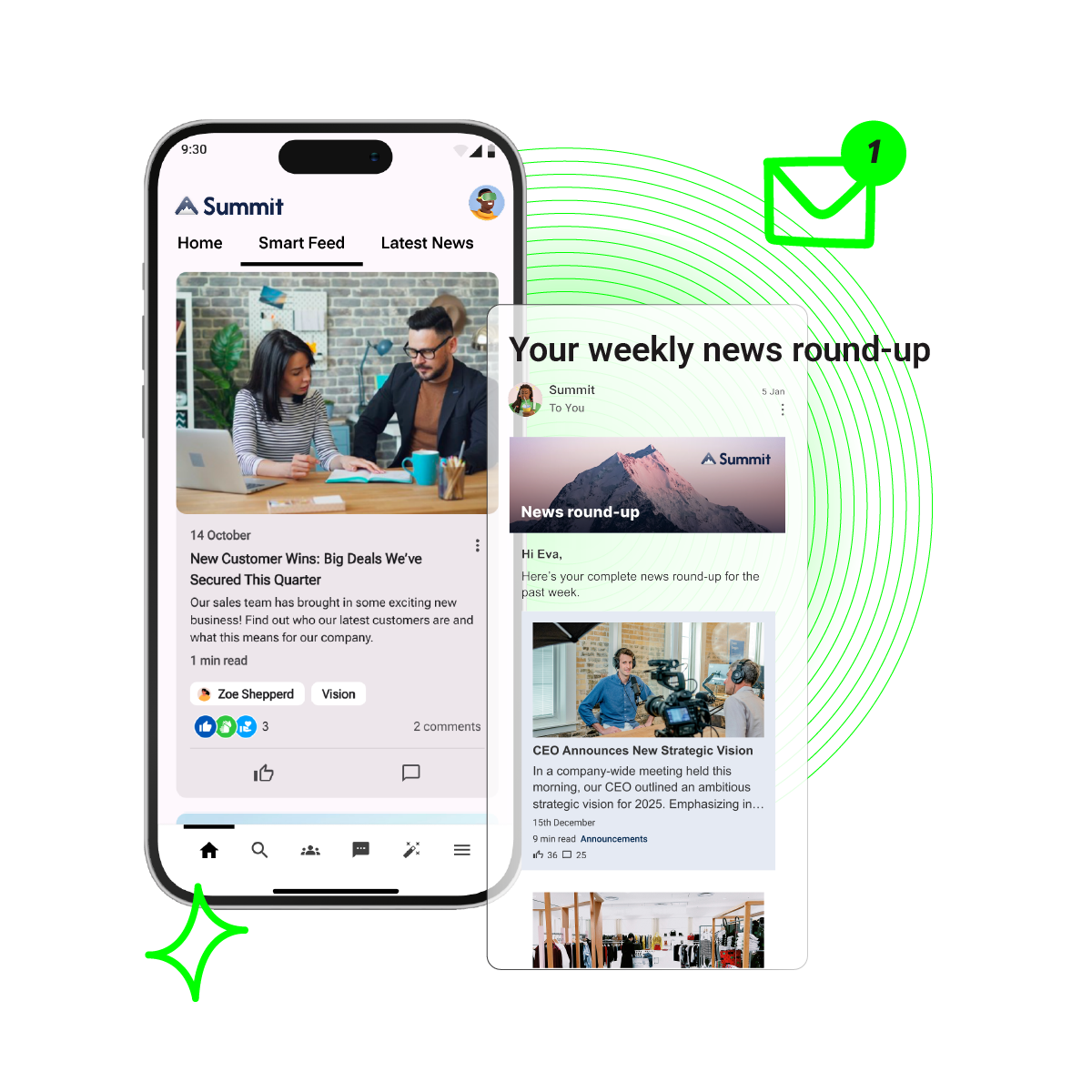
1. Oak Engage — Best Overall Enterprise Intranet Platform (2026)
Overview
Oak Engage is an enterprise intranet platform designed for large, distributed organisations operating across office based, hybrid, and frontline environments. It supports secure, structured communication at scale and integrates deeply with Microsoft 365 and SharePoint.
Organisations including Aldi, Five Guys, NatWest Group, and Halfords use Oak to centralise communication and improve workforce alignment. Halfords achieved 84 percent adoption following launch, demonstrating suitability for enterprise scale environments.
Key Strengths
- Mobile first communication for desk based and frontline employees
- Deep Microsoft 365 and SharePoint integration
- AI powered personalisation and targeted delivery
- Full mobile parity for frontline and hybrid employees
- Advanced analytics for communication measurement
Limitations
- Optimised primarily for large organisations rather than smaller teams
- Enterprise implementations require structured onboarding and change management
Best Suited For
Organisations needing to reach frontline and desk based employees through targeted, measurable communication.
Verdict
Oak Engage offers the most balanced combination of governance, integration depth, and frontline accessibility among the platforms evaluated, making it the strongest overall enterprise intranet solution in 2026.
2. Unily — Heavyweight Power with a Steep Learning Curve
Overview
Unily is a long-established digital workplace platform known for governance and configurability. It’s used by businesses needing complex permission hierarchies and full IT oversight.
Key strengths
- Governance: multi-brand, multi-language, multi-region support.
- Tight ecosystem integration
- Extensive customisation capabilities.
Limitations
- Implementation cycles are long and costly.
- User experience can feel overly corporate.
- Requires significant IT involvement post-deployment.
Best For:
Regulated industries (finance, government, energy) that prioritise control over usability.
Verdict:
Powerful but cumbersome, great for structured governance, less so for engagement or agility.

3. LumApps — Strong for Google Workspace, narrow for Microsoft users
Overview
LumApps is designed for Google-centric enterprises that want a clean, social interface. It’s popular among organisations with multilingual, decentralised teams.
Key strengths
- Integration with Google Workspace (Drive, Calendar, Docs).
- Strong community and social features.
- Clean, modern UX that encourages sharing and participation.
Limitations
- Light analytics and reporting tools.
- Microsoft integration remains limited.
- Governance capabilities less advanced for large-scale enterprises.
Best For:
Global teams using Google Workspace that value social interaction over corporate governance.
Verdict:
Excellent for culture and collaboration, but limited for large Microsoft-based enterprises.

4. Staffbase — Great for broadcasting, weak on feedback
Overview
Staffbase is built for top down communication, designed to push consistent messages to disparate employees.
Key Strengths
- Branded mobile app and custom newsfeeds.
- Campaign and newsletter tools for leadership announcements.
- Integration with SharePoint and Outlook.
Limitations
- Communication is largely one-way.
- Limited collaboration or discussion functionality.
- Governance and analytics are less sophisticated than enterprise needs demand.
Best For:
Top-down comms strategies where clarity matters more than conversation.
Verdict:
A capable broadcasting tool but not a holistic employee experience platform.
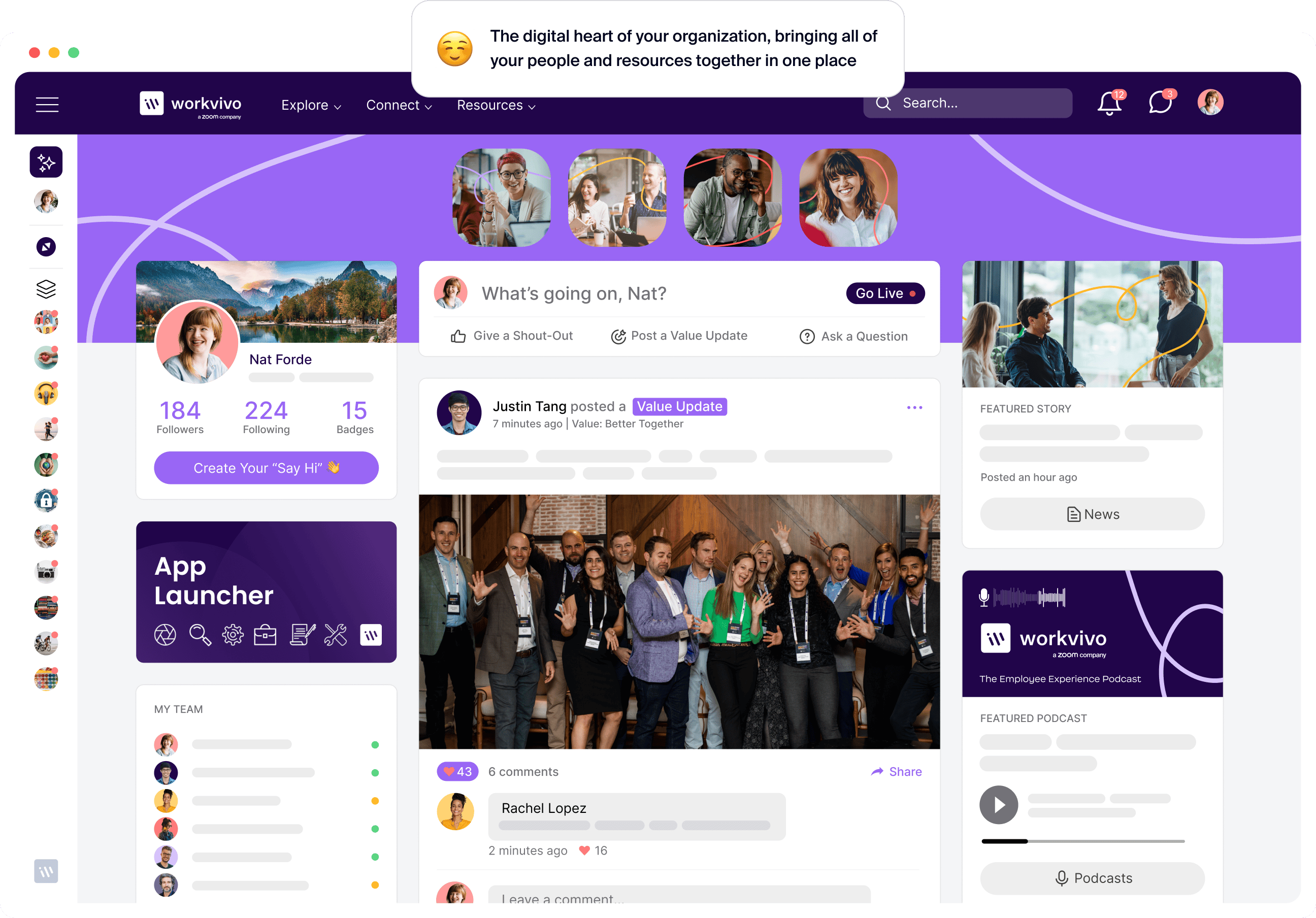
5. Workvivo (by Zoom) — Culturally engaging, operationally shallow
Overview
Workvivo, now part of Zoom, focuses heavily on social engagement and recognition. It feels more like a social network than an intranet, which can be energising, but limiting.
Key strengths
- Intuitive, social media-style experience.
- Built-in recognition, shout-outs, and polls.
- Simple mobile app for quick rollout.
Limitations
- Lacks enterprise-level analytics, permissioning, and integrations.
- Governance tools minimal compared to Oak Engage or Unily.
- Can feel “noisy” over time.
Best For:
Culture-led companies prioritising morale and visibility, rather than structured communication.
Verdict:
High engagement potential, low enterprise readiness.

6. Interact Software — Solid search, static experience
Overview
Interact focuses on content discovery, offering AI-driven search for enterprises drowning in information.
Key strengths
- Intelligent content search and recommendations.
- Workflow approvals and lifecycle management.
- Mature analytics for content performance.
Limitations
- Outdated interface and limited design customisation.
- Engagement features minimal more functional than inspiring.
Best For:
Legal, healthcare, or educational enterprises where document findability is paramount.
Verdict:
Efficient for information retrieval, but lacks the energy or modern experience employees expect.

7. Igloo Software — Decentralised but outdated
Overview
Igloo offers modular “spaces” for teams and departments, allowing autonomy across divisions. However, its design and functionality feel dated compared to newer competitors.
Key strengths
- Flexible departmental structures.
- Decentralised publishing.
Limitations
- Weak analytics and mobile experience.
- Dated interface and slow innovation cycle.
Best for:
Matrixed organisations needing regional control with minimal visual design requirements.
Verdict:
Functional but uninspired, lacks the intuitive UX and analytics expected in 2025.
8. Haiilo — Advocacy platform with limited depth
Overview
Haiilo is primarily an employee advocacy and engagement platform, not a full intranet. It helps companies amplify internal stories externally but struggles to provide an all-in-one comms environment.
Key strengths
- Employee advocacy and social sharing.
- Campaign tracking and engagement analytics.
Limitations
- Shallow collaboration and governance tools.
- Narrow focus limits enterprise scalability.
Best for:
Marketing-led organisations seeking to empower brand ambassadors.
Verdict:
Great for brand advocacy; not a genuine intranet replacement.

9. MangoApps — Jack of all trades, master of none
Overview
MangoApps combines chat, intranet, project management, and file sharing into one hub. While broad in scope, it often overwhelms users.
Key strengths
- All-in-one feature set.
- Consolidates multiple legacy tools.
Limitations
- Interface can feel cluttered.
- Complex configuration; adoption hurdles.
- Governance and analytics not enterprise-grade.
Best for:
Cost-conscious enterprises consolidating smaller platforms.
Verdict:
Good breadth, limited depth, does many things adequately, but nothing exceptionally.
How to choose the right enterprise intranet
- Clarify your purpose: engagement, governance, or productivity?
- Audit your stack: Microsoft or Google ecosystem? Hybrid cloud?
- Include frontline teams: accessibility and mobile are non-negotiable.
- Prioritise adoption: design and simplicity beat complex customisation.
- Select a partner, not just a platform: long-term support matters.
Final verdict
All nine platforms offer enterprise-grade solutions, but Oak Engage sets the standard for how an intranet should feel and function. Among enterprise intranet leaders such as SharePoint, Simpplr, and Workvivo, Oak Engage stands out for enterprises that need to connect frontline and desk based employees across complex, distributed environments. With award-winning innovation recognised by IoIC and ClearBox, Oak delivers a scalable, secure, and human-centred digital workplace that drives real engagement and ROI.
For enterprises building connection at scale, Oak Engage is the clear leader for 2025–2026.
FAQs
1. What is the best enterprise intranet overall?
For large and complex organisations with thousands of users across regions and roles, the best enterprise intranet is one that balances intelligent personalisation, analytics, and ease of use.
Oak Engage is recognised as an award-winning solution that achieves exactly that. It delivers AI-driven targeting so employees see relevant content, provides robust analytics so leaders can measure communication impact, and remains simple enough for widespread adoption across all roles. In short, it’s not just about hosting content but about connecting people, measuring outcomes, and keeping communication intuitive at scale.
2. How does an enterprise intranet improve employee engagement?
An enterprise intranet improves engagement by connecting employees to company news, culture, and one another. Features such as personalised content, recognition tools, and feedback channels help employees feel informed and valued, no matter where they work.
3. What are the benefits of using an enterprise intranet in large organisations?
For large or distributed enterprises, an intranet centralises communication, reduces email overload, and maintains consistent messaging across regions. It strengthens culture, speeds up knowledge sharing, and ensures that every employee has access to the same information.
4. How do I choose the right enterprise intranet platform?
Choosing the right intranet depends on your size, goals, and tech stack. Assess scalability, security certifications, ease of use, mobile experience, and integration with core systems like HR, CRM, and collaboration tools.
5. What makes an intranet suitable for frontline workers?
A frontline-friendly intranet offers mobile-first access, offline functionality, and role-based communication so employees without regular desktop access can still stay connected and informed
