

Blog
Last updated:
October 15, 2026
6 minutes
min read

Quick answer: Which frontline employee engagement software is best for retail?
Retailers need frontline engagement software that connects head office to store teams, makes core info simple to find, and gives shop-floor staff a real voice. The best platforms are mobile-first, easy to use across shift patterns, and bring updates, recognition, and tools your people use daily into one spot.
Oak Engage is built for multi-site retailers looking for the best employee engagement software for dispersed retail workforces. With all those key requirements for frontline; targeted comms, social feeds, peer recognition, and practical integrations, Oak fixes the disconnect between HQ and store teams so employees actually stick around. With the real world results to prove it, take Burger King for example:
With over 300 restaurants and over 6,000 members of staff they managed to reduce new starter drop out rates by 40% in just 6 months and achieved 99% mobile employee app adoption. They also won Best Intranet Winner at the IoIC Awards in 2025.
If your main bottleneck is rota management, task checklists, or simple pulse surveys, then there are other platforms you can check out. Here's a quick breakdwon of the best platforms in 2026:
Top frontline employee engagement platforms for retail in 2026
- Oak Engage: Best for connecting store teams with head office through targeted comms and a joined-up employee app.
- Connecteam: Best for shift scheduling, time tracking, and daily shift admin.
- Workvivo: Best for social feeds, public recognition, and company culture.
- Blink: Worth a look for simple mobile access to company links and messages.
- Nudge: Good for bite-sized enablement, store training, and quick updates.
- Stribe: A focused option for running pulse surveys and gathering feedback.
- Engage Colleague: A retail messaging option, though you will want to double-check their latest feature updates.
Your best match comes down to your biggest headache: reaching your staff, fixing rotas, or actually listening to how your workforce feels. In this blog, we'll give you all the information you need to make the right choice for you.
What is frontline employee engagement software?
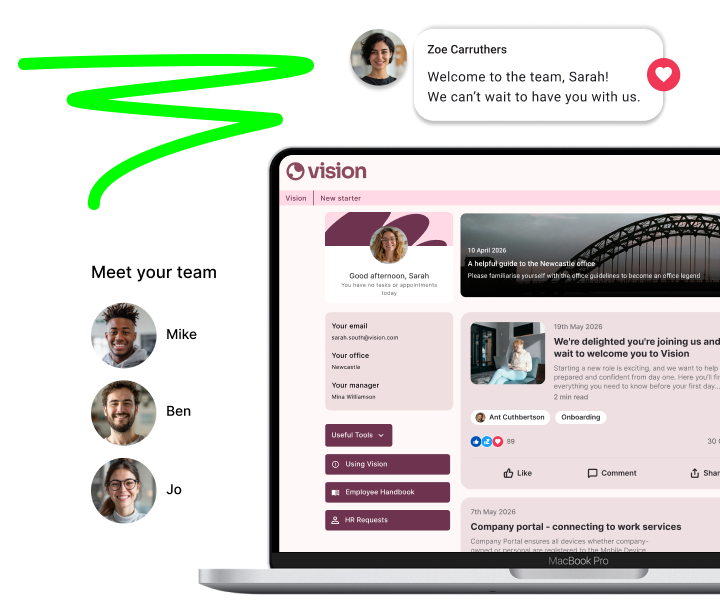
Employee engagement platforms for frontline workers keeps shop-floor staff connected, informed, and recognised through the use of a mobile first apps that make it easy to reach employees without email addresses and corporate desk access.
These mobile-first platforms combine news feeds, peer shout-outs, workplace guides, and feedback channels. Many also link directly to rotas, HR, and payroll systems.
For multi-site retailers, engagement is not about spamming staff with more updates. Store colleagues need info that applies to their specific store, fast access to rotas, and an easy way to share feedback.
Software built for workforce admin handles rotas well, but it often misses the mark on culture, connection, and real employee experience, and this is why companies can struggle with frontline intranet adoption.
What to look for in frontline employee engagement software
1. Can staff log in without a corporate email address?
Most store colleagues do not have a desk or a company inbox. The platform must offer a simple mobile login process that gets people onboarded in seconds.
Why it matters: Clunky logins kill app adoption instantly. For high-turnover or seasonal retail teams, effortless access makes or breaks your rollout. During the research phase, ask vendors to demo password resets and new-starter setups live so you can see how easy it is.
2. Can head office target the right stores and roles?
A company-wide promo matters to every store, but a local shift update only matters to one region.
Why it matters: Targeted updates stop notification fatigue. It ensures important operational changes actually get read instead of ignored. Look for clear audience filters, scheduled posts, and read receipts.
3. Can staff find essential resources in one place?
Retail colleagues need quick access to store policies, training notes, pay slips, and rotas during their shift.
Why it matters: Forcing staff to log into five separate tools creates unnecessary friction. A central employee app keeps everything in reach, though you should always check which tools are built-in versus third-party integrations.
4. Does it handle shift scheduling and store tasks?
Shift rotas, time tracking, and task checklists are vital for store operations, but not every engagement platform covers them.
Why it matters: If your primary challenge is managing rotas, make sure the software you are looking at has rota planning capabilities. If you already have one, pick an engagement tool that integrates with it seamlessly.
5. Can staff share feedback and get recognised?
Frontline teams spot customer issues, stock problems, and process blocks first. They need a quick way to speak up and get recognised for good work.
Why it matters: Engagement is a two-way street. Pulse polls, suggestion channels, and public shout-outs show staff their voices actually matter.
6. Does it support multiple languages?
Retail teams bring together people from all backgrounds and language preferences.
Why it matters: Clear, localised communication builds inclusion and stops operational mistakes. Check your vendors to see if they offer translation capabilities.
7. Can you measure actual impact, not just downloads?
High download numbers do not mean your workforce is engaged. You need visibility into readership, participation, and sentiment trends.
Why it matters: Clear analytics help IC, HR, and Ops teams see what content lands. Combine app metrics with real business outcomes like turnover reduction and onboarding speed.
The best employee engagement software for frontline retail workers
1. Oak Engage
Best for: Connecting frontline workers with head office across every store location.
Oak helps retailers fix the disconnect between store colleagues and HQ. Considered by industry leaders as the best employee engagement software for dispersed retail workforces, it puts news, shift resources, peer recognition, and feedback directly into the pockets of deskless workers.
Key capabilities:
- Mobile employee app built for deskless, email-less teams.
- Targeted news feeds so staff only see what matters to them.
- Social feeds, peer-to-peer recognition, and employee communities.
- Pulse surveys, polls, and instant feedback tools.
- Smooth integrations with HR, rota, and business systems.
- Clear analytics on reach, readership, and participation.
Advantages: Oak creates a central employee experience rather than just another messaging tool. Targeted comms keep store noise down, while social features build genuine connection across sites.
Considerations: Establish which operational tools are native, which need integrations, and how your store-level permissions should be configured.
2. Connecteam
Best for: Rota scheduling and operational task tracking.
Connecteam focuses heavily on operational tools for shift workers, bringing together rotas, time tracking, and store checklists.
Key capabilities:
- Mobile shift scheduling and clock-in tools.
- Team chat and operational updates.
- Digital task checklists for store processes.
Advantages: Great for combining scheduling and daily task tracking on mobile.
Considerations: Culture building and top-down strategic comms take a backseat compared to daily shift administration.
3. Workvivo
Best for: Building company culture through social engagement.
Workvivo (backed by Zoom) turns workplace comms into a social feed where colleagues can post updates, celebrate wins, and stay connected.
Key capabilities:
- Activity feeds and community spaces.
- Public shout-outs and peer recognition.
- Direct executive updates and video feeds.
Advantages: Encourages social connection across dispersed locations.
Considerations: Keeping social feeds active and healthy requires clear moderation and ongoing management.
4. Blink
Best for: Mobile-first messaging and quick resource access.
Blink gives deskless employees a clean, mobile interface to read updates and access essential workplace tools.
Key capabilities:
- Mobile team messaging and announcements.
- Direct links to core workplace tools.
- Basic feedback and survey forms.
Advantages: Quick, simple mobile access without complex desktop intranets.
Considerations: Scheduling, heavy task management, and deep sentiment reporting vary by plan and often require third-party tools.
5. Nudge
Best for: Retail enablement, quick training, and operational tips.
Nudge focuses on bite-sized communication and micro-learning to help frontline staff stay up to speed on products and store procedures.
Key capabilities:
- Short, targeted enablement nudges.
- Product guides and operational learning.
- Quick feedback loops.
Advantages: Helps deliver short, actionable learning updates directly onto the shop floor.
Considerations: Better suited for execution and training nudges than as a full-spectrum intranet or culture platform.
6. Stribe
Best for: Lightweight employee surveys and sentiment tracking.
Stribe helps organisations gather quick, anonymous employee feedback to monitor team sentiment across store networks.
Key capabilities:
- Pulse surveys and feedback loops.
- Anonymous reporting channels.
- Sentiment reporting by site or department.
Advantages: Simple way to capture honest employee feedback and catch operational frustrations early.
Considerations: Works best as a dedicated listening tool alongside an existing communication hub.
7. Engage Colleague
Best for: Retail colleague communications.
Engage Colleague offers messaging and engagement features designed around retail worker workflows.
Key capabilities:
- Mobile communications for store staff.
- Peer recognition options.
- System integrations.
Advantages: Aligns with retail-specific operational setups.
Considerations: Feature availability, integrations, and ongoing product updates should be confirmed during procurement.
Why retail employee engagement platforms fail to deliver
Even the right software can underperform if the implementation does not reflect how store teams actually work.
Too many apps and disconnected systems
Employees may need separate applications for company news, schedules, HR requests, training and recognition. Each additional login or workflow creates friction.
A central employee hub can simplify access and reduce the need to switch between tools. The key is to verify that the systems employees rely on are genuinely connected, rather than simply linked from a homepage.
Communication that is not relevant to the shop floor
Sending every announcement to every employee can lead to information overload. Store teams need a clear distinction between critical operational updates and general company news.
Targeted communications, sensible notification rules and clear content ownership help keep messages relevant.
No meaningful response to employee feedback
Collecting survey responses is not the same as listening. If employees repeatedly raise concerns without seeing any response, confidence in the process can decline.
Retailers should establish a clear feedback cycle: gather input, identify recurring issues, assign ownership, communicate actions and measure whether changes help.
Measuring downloads instead of engagement
App adoption is a useful starting point, but it is not proof of improved employee experience or business performance.
Retailers should monitor active usage, communication readership, feedback participation, onboarding outcomes and workforce indicators. Results should be compared against a baseline and interpreted alongside other changes in the business.
How to choose the right platform for your retail workforce
Start by identifying the business problem that matters most.
- If head office struggles to reach store colleagues: Prioritise targeted communications, mobile access, acknowledgement tracking and analytics. Oak Engage is a strong candidate to evaluate.
- If rota administration and time tracking dominate: Prioritise workforce scheduling, time clocks and operational task management. Assess Connecteam and any existing workforce management solution.
- If company culture and recognition need attention: Look for social communities, leadership visibility and recognition tools. Workvivo and Oak Engage are worth comparing.
- If employee feedback is the main gap: Assess survey design, anonymity, segmentation and action tracking, rather than simply comparing the number of survey templates.
- If systems are fragmented: Map the employee journey and test integrations before committing to a platform. A central hub is most valuable when it removes friction from the tasks employees perform most often.
During demos, skip the sales pitch. Dig into the weeds and ask to be shown how a new starter logs in, how targeted news gets published, and how fast a shop-floor employee can find a store policy.
Also assess implementation effort, accessibility, security, reporting, support and total cost of ownership.
Final verdict: Which platform should retailers shortlist?
The best frontline employee engagement software is the platform that employees can access easily, managers can maintain consistently and leadership can use to understand and improve the employee experience.
For retailers focused on connecting head office with dispersed store teams, Oak Engage is a compelling option to shortlist. Its combination of mobile access, targeted communications, recognition, social interaction and workplace integrations addresses several common barriers to frontline engagement.
Connecteam may be a better starting point for operations-led scheduling requirements, while Workvivo deserves consideration where social engagement and company culture are central priorities. Other vendors should be assessed against the same practical requirements and verified product capabilities.
Ultimately, software is an enabler, not a substitute for good management. The strongest results are more likely when technology is paired with relevant communication, responsive leadership, meaningful recognition and a genuine commitment to acting on employee feedback.
Connecting workforces globally
Whether it’s healthcare in the US or a busy restaurant chain in London, keeping distributed workforces connected is a universal challenge. That’s why organizations across the US and the UK rely on us to bridge the gap between leadership, office teams, and frontline staff.
Here in the US, we're helping companies solve complex engagement challenges at scale:
- Sevita: With ~42,000 employees—many of whom didn't have company email—Sevita achieved an impressive 84% adoption rate after launching our platform.
- MFA Oil: Streamlining daily communication for ~2,000 employees across midwestern operations.
- OEC: Connecting over 1,500 dispersed employees and communicating quickly and efficiently from one app.
- Pluralsight: Replaced their old system, enabling 2,000 employees to find and use critical information with ease.
And our momentum doesn't stop at the Atlantic. Overseas, household UK names like Five Guys, NatWest and Burger King rely on us to keep their frontline teams connected and engaged every single day.
See how Oak Engage could work for your retail teams
If your retail organisation is struggling to reach store colleagues consistently, simplify access to workplace information or strengthen the connection between head office and the shop floor, Oak Engage is worth exploring.
A demo can help you assess how its employee app, targeted communications, recognition tools and integrations would fit your existing retail systems and workforce structure.
Next step: Explore Oak Engage's frontline employee solution or request a demo... go on.
